This article is an interesting look at Lincoln and Manchester during the time of the Cotton Famine.
In 1863, The US President wrote to the ‘working men of Manchester’ thanking them for their anti-slavery stance
In an age when cotton was king and Manchester’s textile mills were dressing the world, great fortunes were made many families were fed. In 1862, Lancashire mill workers took a stand, at a great personal sacrifice, they refused to touch raw cotton picked by US slaves.
In America, President Lincoln’s Northern Union was at war against a breakaway of southern states and the south was already linked with the institution of slavery, Lincoln persuaded importers in Europe importers to create a blockade of slave-picked cotton which was a legitimate tool to defeat the Confederacy enabling the restoration of the union.
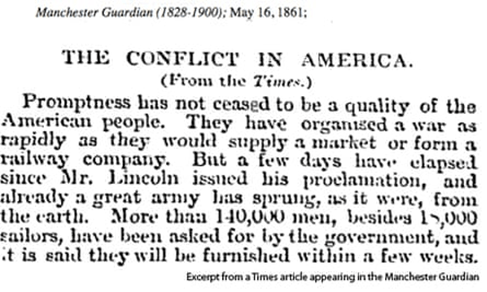
After a year into the civil war, the cotton embargo began to bite and Lancashire mills, which import three-quarters of all cotton grown on southern plantations (1.3 billion lbs), found that 60% of its spindles and looms lay idle, which left many people out of work, mainly due to the blockade.
Even though the British government loosely supported Lincoln, many of the mills and shipping owners wanted the Royal Navy to smash through the blockade, which would allow the cotton back into Europe. Liverpool was made wealthy by cotton imports, and “it was said that there were more Confederate flags flying along the banks of the Mersey than in Virginia.”
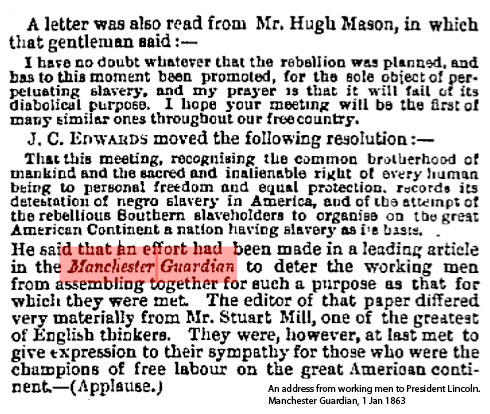
The ‘cotton famine’ was now taking a firm grip, “even the Manchester Guardian instructed the mill hands that they were better off dropping their support for the embargo. However, at a noisy meeting at the Manchester Free Trade Hall in 1862, in a historic show of solidarity against slavery, the workers agreed to keep supporting Lincoln’s embargo.”
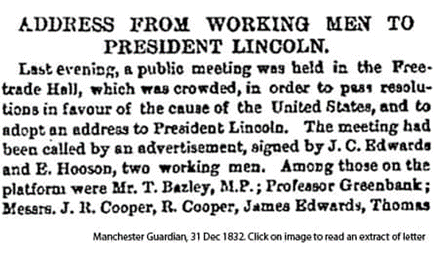
This was an extraordinary gesture, as the vote would cost the mill workers a great deal, as most of them would be facing starvation and destitution. It became known, that disorder had started in many northern towns, and “the army having to read out the Riot Act.”
Now with the cotton industry on its knees, the American president acknowledged “the self-sacrifice of the ‘working men of Manchester’ in a letter he sent them in 1863.” Which was later “inscribed on the pedestal of his statue that can still be found in Lincoln Square, Manchester – praised the workers for their selfless act of “sublime Christian heroism, which has not been surpassed in any age or in any country.”
These words from President Lincoln followed the arrival of US relief ships which were packed with “provisions sent by grateful Americans as an act of brotherhood between the Union states and Lancashire.”
In January 1865 Congress passed the Thirteenth Amendment abolishing slavery throughout America – only months before Lincoln was assassinated by John Wilkes Booth. Whilst the US Constitution was in the process of being rewritten, “the Confederate states, already stricken by the embargo, were being defeated by Union forces, and when the South surrendered, Manchester had dusted down its disused mills and workshops to begin the difficult task of recapturing its lost industrial might.”
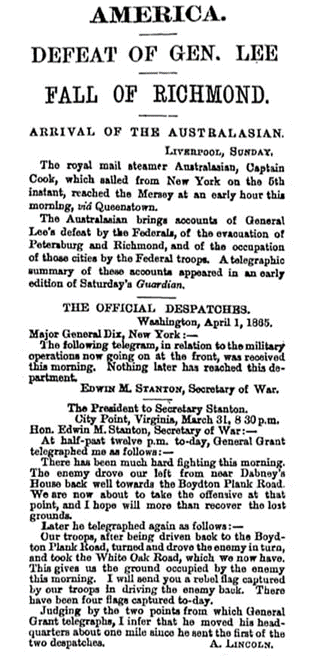
Manchester Guardian, 21 April 1865.
Rodrigues, J. (2013). Lincoln’s great debt to Manchester. The Guardian. [online] 4 Feb. Available at: https://www.theguardian.com/theguardian/from-the-archive-blog/2013/feb/04/lincoln-oscars-manchester-cotton-abraham [Accessed 14 Mar. 2023].
 Rachel Bakewell