Jon Howe: Original Author of this article. A Leeds-based freelance writer and author.
We can look back through history, and peel away the layers of time where everything is revealed. Except that the full harvest of some of the rudimentary practices from our industrial evolution aren’t always immediately evident to the 21st century eye. Intrigue should always play a part in how we imagine and discover all of our yesterdays, and with so much still to discover, our hunger for history would be satiated and we could firmly close the book on the past. This is why a recent discovery at a famous Yorkshire mill has opened up a fascinating portal into this region’s rich textile heritage, whilst also enabling a journey into an arresting and innovative future.
It was whilst working on a Future Fashion Factory-funded project with Yorkshire Textiles – in collaboration with Royal Warrant holder AW Hainsworth, established in Leeds over 230 yrs ago, and textile designer Rebecca Ough – that the discovery was made at Armley Mills Leeds Industrial Museum of jacquard loom punch card patterns. Armley Mills was once the world’s largest woollen mill and today,where Leeds Industrial Museum run by Leeds City Council, houses examples of textile manufacturing that span much of the region’s Industrial Revolution.
Rebecca Ough, together with Yorkshire Textiles – an alliance of people and organisations dedicated to the promotion of textiles, quality fashion, innovation and skills in the Leeds City Region, led by Suzy Shepherd – has now embarked on a new project with CEG’s Temple development in Holbeck, Leeds which perfectly adopts its masterplan vision for capturing the past, present and future of the city’s industry.
The punch cards which were discovered had been used for textile production in the early 1900s, but nobody knew what pattern they had produced. These cards were an early form of binary code, and were effectively the first form of modern day computers, as they transmitted the code from these unwieldy plates to weaving machines, which would interpret them and produce a pattern in cloth.
As part of the Yorkshire Textiles project, Rebecca translated the cards into a pattern. It was something of a voyage of discovery for Rebecca, even though she possesses a vast technological knowledge of textile techniques both old and new, and is practised in updating these methods to embrace modern technologies and reduce waste. She knew what the cards were for, but not what pattern they would produce, so she meticulously digitised the process and interpreted the information on the cards to reveal a pattern designed over 100 years ago.
“Armley Mill/Leeds Industrial Museum provides a great insight into weaving practices of the past,” Rebecca begins “some which are still used in the industry today. They have a working spinning mule along with punch card operated Jacquard looms.”
Immediately we have a window into the past, but we are not merely historical bystanders, we can now actively take part and touch the bygone era when Yorkshire’s textiles were established as world leaders. Although today the volume of manufacturing is no longer on such a vast scale, the reputation and modern day relevance to the international market has stood the test of time, in terms of luxury and innovative textiles. And it is this passion for adapting classic techniques for use in the hectic maelstrom of contemporary life that makes this region so relentlessly challenging and boundary-shifting.
With the Temple development so inherently enveloped in the epoch-defining textile history of Leeds, it was a natural step to utilise this digitisation of traditional techniques to perfectly embody an identity which richly cherishes its past and looks forward to a bright and progressive future. As such, following a brainstorming session with Suzy Shepherd, CEG has commissioned Yorkshire Textiles and Rebecca Ough to use these newly-refined techniques and this cross-translation of traditional skills to produce a ‘heritage weave’, which will be used across the Temple development to bring its textile legacy back to life and remind the reformist pacesetters of today what happened here first.
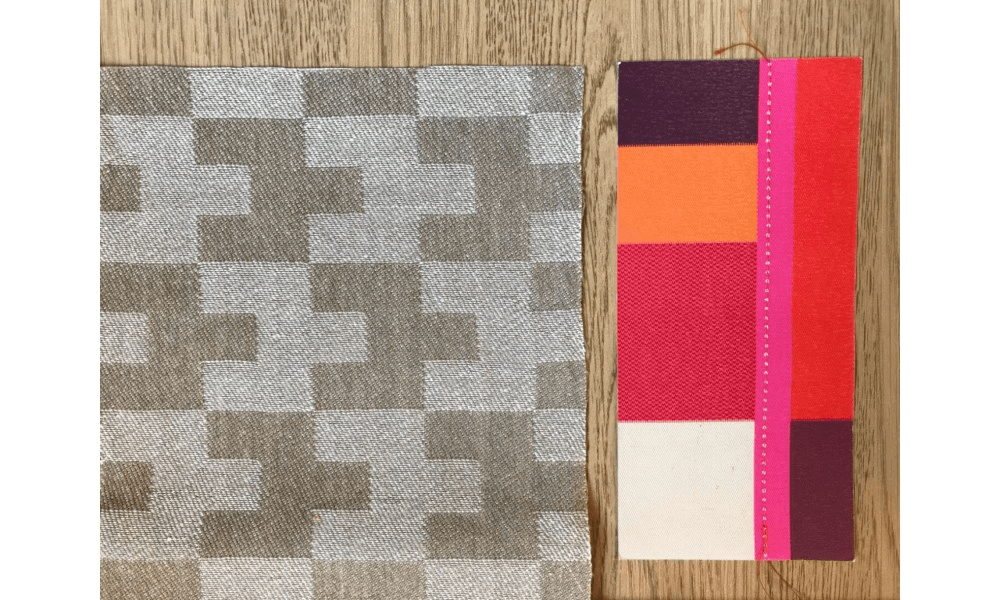
The ‘Temple Weave’ has been hand-woven by Rebecca using these digitised techniques, and the design has used palette colours inspired by the Egyptian Revival style, as a homage to the charm and mystique of the wonderful Temple Works; the anchor component of the Temple development. Rebecca has gone to painstaking lengths to find yarns that match the red, pink and brown palette colours put together by Thompson Brand Partners for the Temple branding guidelines, and has reversed the binary card process to ‘un-digitalise’ a design, and having unpicked it, to allow the production of beautiful woven samples.
“My design process always starts with manually drawing out weaving structures,” Rebecca continues “I took inspiration from the digital imagery which CEG provided me, and translated these into woven designs on my CAD software. Selecting materials is the next stage, and one of the most important, in my design process; I took inspiration from Temple Works’ interesting history in flax spinning and included flax fibre in the form of linen for the weft, and a worsted wool yarn in the warp. Making hand woven samples is the final realisation of designs, it’s a great chance to test out different materials and weaving patterns and it provides a really tactile outcome. This can then be scaled up to be larger hand woven pieces, or can be taken to be manufactured at one of the many textile mills in the area.”
As it stands, Rebecca has produced a number of samples using her own loom to replicate the ‘Temple’ pattern. The idea is for Rebecca to ‘scale-up’ the samples by hand-weaving them to full-sized pieces of artwork. There are a multitude of potential further uses for the final pieces as upholstery fabrics and other interior fabrics, as well as large-scale artworks across the various buildings and areas of public realm within the Temple district.
First and foremost, however, this is an exciting and innovative way of bringing traditional weaving methods into the 21st century and making them available for further development.
“This process directly relates to traditional weaving methods,” Rebecca explains “machinery and technology may have advanced, but the fundamentals of weaving remain unchanged. The warp yarns still interlace with the weft yarns in the same way as they always have. Weaving has become more efficient with the use of digital technology but the concept and the craftsmanship of weaving will always be significant.”
Matching the “Egyptian” palette colours accurately was a huge test and indeed, other colours had to be added. This was not the only test of Rebecca’s skill however, and a further tribute to Temple Works and John Marshall’s contribution to industrial development in Leeds was another meticulous task:
“One of the main challenges I encountered with the creation of the Temple Weave,” Rebecca explains “was the use of linen yarn. Linen can be a difficult yarn to work with because it has a relatively low extension, it can be quite unforgiving when weaving! I overcame this with the use of wool in the warp.”
Challenges and Triumphs
Working with linen yarn—a nod to Temple Works’ history in flax spinning—posed challenges due to its low elasticity, but Rebecca’s solution of combining it with wool ensured the weave’s success. The project not only celebrated traditional techniques but also demonstrated their adaptability in a modern context.
A Legacy for the Future
The Temple Weave project highlights the importance of preserving and adapting traditional skills for future generations. Rebecca’s work, rooted in Yorkshire’s textile culture, illustrates how innovation can breathe new life into historical practices. By integrating heritage with contemporary design, projects like Temple Weave inspire sustainable, creative development.
“Passing on knowledge and expertise is vital for keeping any industry alive,” Rebecca emphasizes. The success of the Temple Weave project is a testament to the enduring legacy of Yorkshire’s textile industry and its potential for innovation.
Conclusion
The discovery at Armley Mills and the subsequent Temple Weave project represent more than just a nod to the past—they are a celebration of the interplay between history and progress. By blending traditional craftsmanship with modern techniques, Yorkshire’s textile heritage continues to influence and inspire. As the Temple development takes shape, it stands as a symbol of how honouring the past can lay the foundation for a vibrant and innovative future.
For references and further information:
Original Article Written: SEPTEMBER 10, 2020
- Leeds Industrial Museum at Armley Mills: Leeds Museums and Galleries
- Future Fashion Factory: Future Fashion Factory
- AW Hainsworth: Hainsworth
- Rebecca Ough’s Salt Weave Studio: Salt Weave Studio
This project exemplifies the vitality of Yorkshire’s textile narrative, weaving together history, innovation, and community.
#TempleWeave #InnovativeTextiles #Sustainable #Yorkshire’sTextileHeritage #Yorkshire’sTextileCulture #TextileLegacy #TextileHistory #InnovativeTextiles #TextileTechniques #TextileProduction #Textiles #Textile #Innovative #TextileDesigner
 Rachel Bakewell