Whenever I write about famous designers, I approach them with care, as I know they put immense effort into protecting their work and creative vision. This is completely understandable, but I also feel that it’s important to shine a light on those designers who are pushing the boundaries of traditional fashion by embracing a more sustainable approach to the fabrics they are using and innovative techniques. Before diving into this post, I want to make it clear that my goal is to share the inspiring work of these visionary designers with a wider audience. I’m not here to promote myself or my work—what I do doesn’t come close to the brilliance of these talented individuals in the fashion world. Instead, I want to highlight how they are transforming the industry, one stunning creation at a time.
Fungi-Inspired Fashion: Iris Van Herpen’s Groundbreaking Spring 2021 Collection
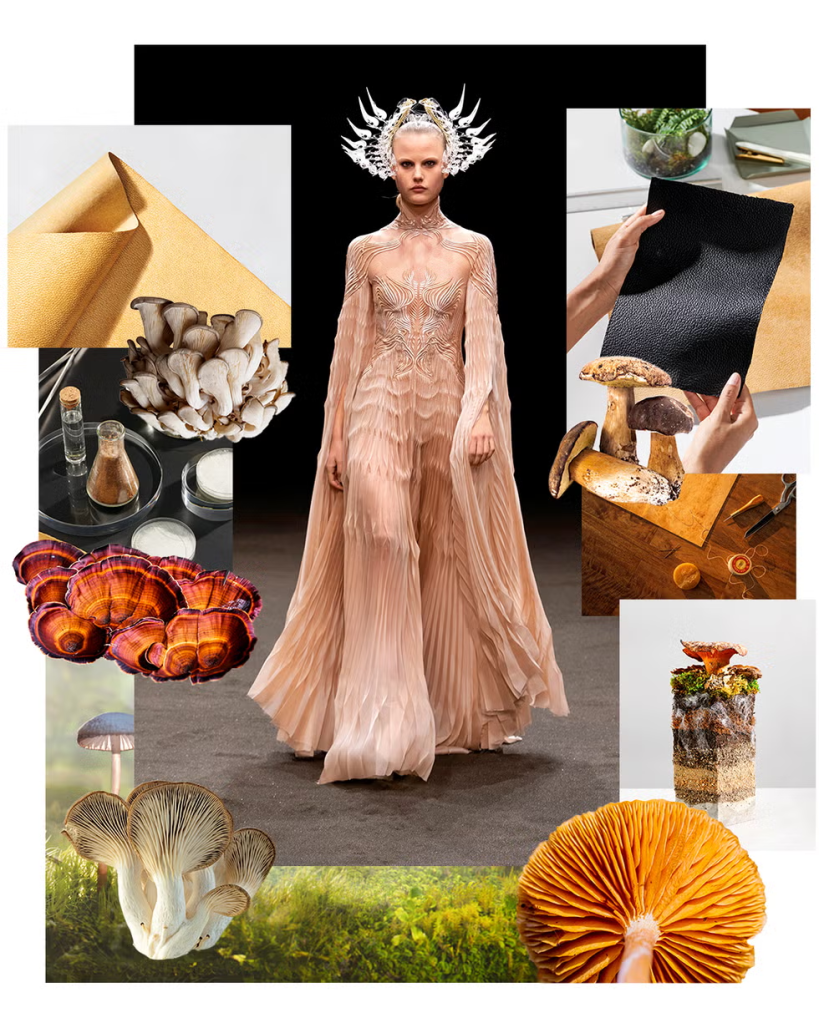
In high fashion, where creativity often knows no bounds, few designers are as boldly innovative as Iris Van Herpen. Her Spring 2021 couture collection is a testament to this, by drawing inspiration from an unlikely source: fungi. The collection is full of wondrous, otherworldly designs—that feature undulating crowns of brass coils with delicate micro-plissé gowns adorned with sinuous silk tendrils—like nothing else on the runway. The real magic of these designs lies in the concept behind these creations, which were inspired by the hidden life of fungi, specifically mycelium, the underground root-like networks playing a vital role in our ecosystem.
Van Herpen’s interest in fungi came after reading Entangled Life: How Fungi Make Our Worlds, Change Our Minds & Shape Our Futures by biologist Merlin Sheldrake. The book delves into the fascinating world of mycelium and offers a new perspective on nature’s invisible networks, of which mycelium is the structure. Much like the internet, these underground fungal webs connect trees and plants and enable communication and resource sharing across vast distances. “It is beautiful to see that within nature there is already this ‘wood wide web’ that shows very strong parallels to our own digital communication systems,” Van Herpen says, referring to the intricate ways mycelium links life forms in nature.
Nature as a Platform for Fashion Innovation
As the COVID-19 pandemic unfolded, Van Herpen reflected on humanity’s vulnerability and how fragile our existence is on Earth. For her, this global moment of reckoning prompted a deeper connection to nature with a desire to use her platform for more than just aesthetic innovation. “During the pandemic, there has been a realisation of our own fragility on this planet,” she explains. “More and more I started to see couture as a platform for new ideas.”
This shift in perspective pushed Van Herpen further towards her exploration of sustainability, which is a cause she has championed for years through her use of 3D printing and other eco-friendly technologies. The 3D-printed elements in her Spring 2021 collection represent a marriage of futuristic design and natural processes, that are a reflection of her belief that fashion can inspire change and promote a more responsible practice within the industry.
Fungi as a Metaphor for Connection and Resilience
The parallels between mycelium and the digital world aren’t just conceptual—they also speak of resilience, connection, and symbiosis. Just as mycelium helps ecosystems thrive through collaboration, Van Herpen envisions a future in the fashion industry that can foster deeper connections between nature, technology, and humanity. In this way, her collection becomes a metaphor for how we are all interconnected, both with each other and with the planet.
These designs are a reflection of this philosophy. Gorgeous flowing gowns, with intricate, web-like patterns and organic silhouettes, seem to echo the natural, organic forms of fungi, whilst also conveying a sense of strength and endurance. The use of brass coils, micro-plissé, and 3D-printed elements showcases a blend of natural inspiration and cutting-edge technology that has become a hallmark of Van Herpen’s work.
Sustainability and the Future of Couture
Van Herpen, an early adopter of 3D printing and a fierce advocate for sustainability, pushes the boundaries of what couture can be. Her designs aren’t just about craftsmanship and artistry but are also about responsibility and innovation. Van Herpen believes fashion has the power to reshape how we think about the world and our place in it, and her Spring 2021 collection is a bold step towards a future where fashion and nature are inextricably linked.
In a world increasingly focused on sustainability, Van Herpen’s high fashion fungi-inspired creations serve as a reminder that fashion can be both beautiful and meaningful. By drawing inspiration from the natural world—and from the complex, interconnection between these systems that sustain life on Earth—she invites us to consider our role in shaping a more sustainable and harmonious future.
In her own words, “More and more I started to see couture as a platform for new ideas.” And with her Spring 2021 collection, Van Herpen has shown that those ideas can be as imaginative as they are impactful.
During the pandemic, there has been a realisation of our own fragility on this planet. More and more I started to see couture as a platform for new ideas.
— Iris Van Herpen —
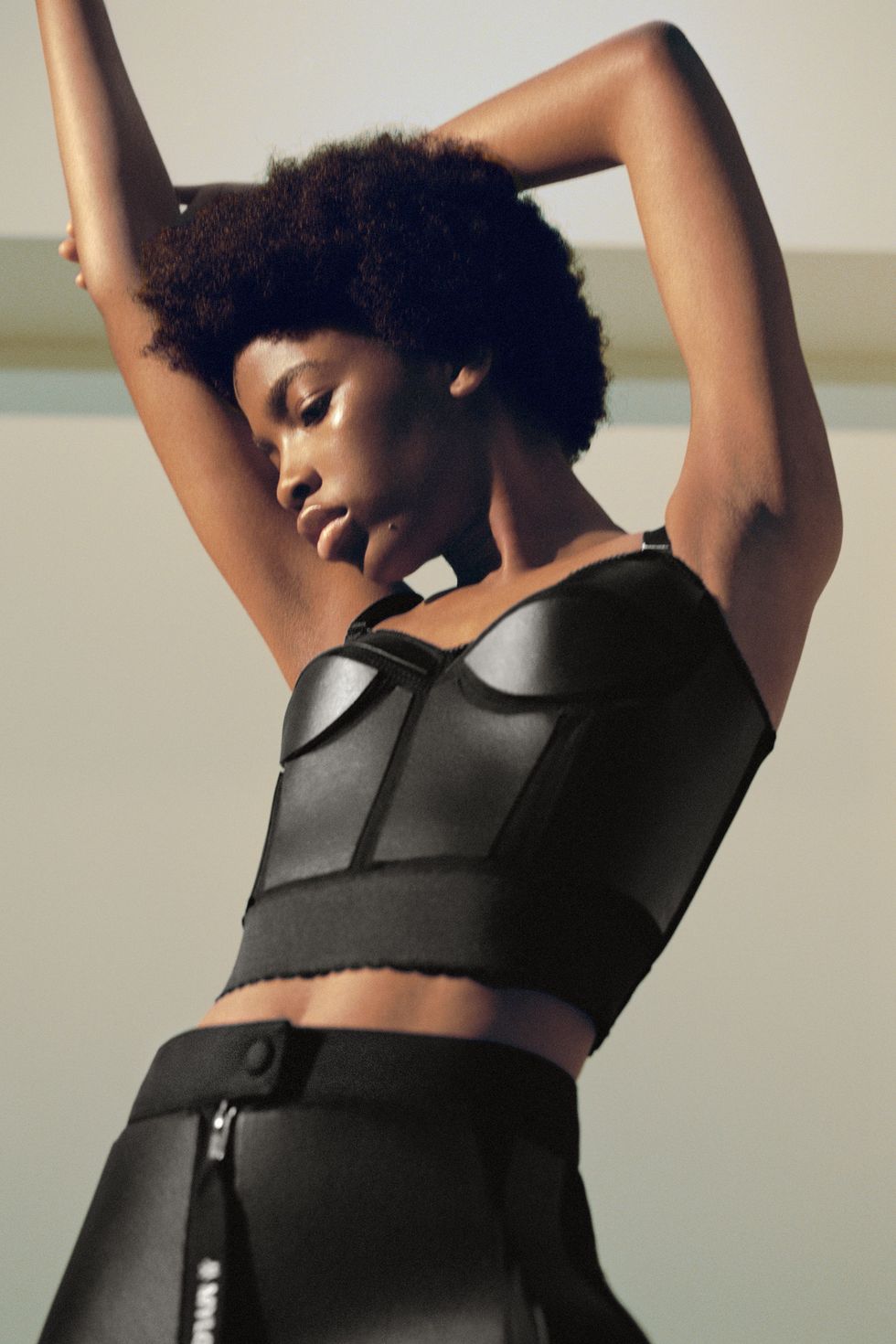 Courtesy Stella McCartney
Stella McCartney bustier top and utilitarian trousers made with Mylo.
In Emeryville, California, a biotech hub in the Bay Area, is where a start-up MycoWorks and Bolt Threads have captured the imagination of luxury brands with mycelium leather. An environmentally friendly alternative to animal and synthetic leathers. this innovative material is grown from fungal spawn in less than two weeks, this new material mycelium leather emits fewer greenhouse gases and uses far less water and land resources than raising livestock to produce animal leather. In fact, since fungi are decomposers and feed on biomass—e.g., dead plants—mycelium leather production is quite literally powered by carbon that is pulled out of the atmosphere. And unlike many synthetic leathers, mycelium leather doesn’t contain petroleum-based materials such as PVC and polyurethane.
If we can get this right and get a viable alternative to leather, then it can really have a huge impact on the planet.
— Stella McCartney —
More than just an eco-friendly leather alternative, mycelium leather has luxury fashion brands excited for the future because of how remarkable the quality of the material is, mycelium leather is buttery soft and supple and Hermès is known for upholding the most stringent standards with its leather, is already experimenting with it. In March, Hermès and MycoWorks unveiled a sample for the French Maison’s Victoria travel bag that is reimagined with Sylvania, an exclusive amber-hued mycelium leather. MycoWorks, who last year raised $45 million in a Series B financing round from investors including Natalie Portman and John Legend, uses a patented technology called Fine Mycelium which grows a dense mesh of mycelium to precise brand specifications for thickness and softness. “We like to say that our vision as a company is to grow the future of materials,” says MycoWorks CEO Matt Scullin. “It’s engineerable and bespoke.” To that end, Sylvania is finished in France at Hermès’s own tanneries. “MycoWorks’s vision and values echo those of Hermès: a strong fascination with natural raw material and its transformation, a quest for excellence, with the aim of ensuring that objects are put to their best use and that their longevity is maximized,” says Hermès Artistic Director Pierre-Alexis Dumas of the unique partnership.
 Coppi Barbieri
Hermès Victoria bag made with Sylvania.
A half-mile from a warehouse holding MycoWorks’s grow trays is the biomaterials company’s main competitor, Bolt Threads. Stella McCartney, a luxury conglomerate Kering, and the sportswear giant Adidas and Lululemon have joined together to help Bolt Threads finance the development of a mycelium leather called Mylo. The raw materials of Mylo are similar to Sylvania—a mixture of fungal spawn and what Bolt Threads Vice President of Product Development Jamie Bainbridge describes as “a secret sauce of agricultural and forest waste”—Mylo grows as a thick foam which is then compressed, dyed, and finished. Stella McCartney, who over the past two decades has set a high bar for the use of green materials, in March unveiled a prototype for a bustier top and utilitarian trousers handcrafted from Mylo panels laid on recycled nylon scuba. “I have always said that I don’t want anyone to know that the products we sell at Stella McCartney are not leather; they should stand shoulder to shoulder with the real thing,” the designer says. “With Mylo, this is something that is grown in labs, which is truly the future. If we can get this right and get a viable alternative to leather, then it can really have a huge impact on the planet.”
#IrisVanHerpen #VanHerpen #StellaMcCartney #Mylo #GreenMaterials #Fungi #Spring2021Collection #Sustainability #Sustainable #Couture #MycoWorks #EcoFriendlyLeather #Hermès #BoltThreads #Sylvania #Lululemon
Media Organisations:
©2024 A Part of Hearst Digital Media
Online: Original article: By Alison S. Cohn Published: May 14, 2021 Bazaar
https://www.harpersbazaar.com/fashion/designers/a36182113/fashion-designers-fungi/
Images:
GETTY IMAGES & COURTESY IRIS VAN HERPEN; BOLT THREADS; MADE WITH REISHITM BY MYCOWORKS.
Websites:
Iris Van Herpen https://www.irisvanherpen.com/
Stella McCartney https://www.stellamccartney.com/gb/en/
Hermes https://www.hermes.com/uk/en/
Bolt Threads https://boltthreads.com/
MycoWorks https://www.mycoworks.com/
 Rachel Bakewell