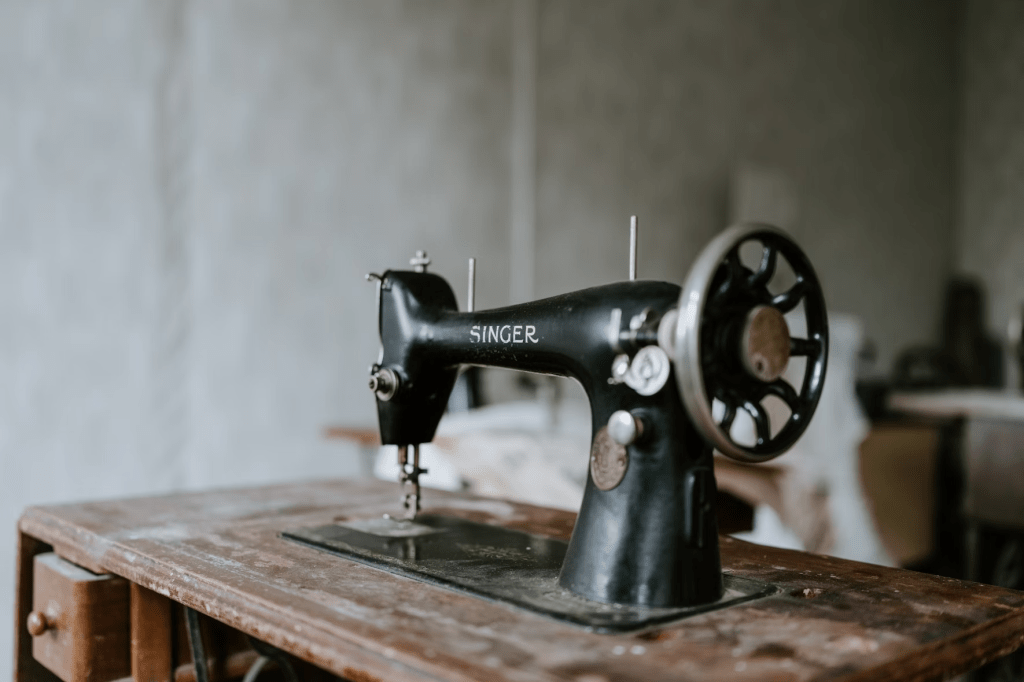
When I first learned that the earliest sewing machines were made left-handed, I was genuinely struck by this fascinating detail. For a tool that is so widely used and would go on to revolutionise the clothing and textile industry worldwide, the idea that its initial design might have unintentionally favoured left-handed users caught my imagination.
A Look at the First Sewing Machines
The first practical sewing machine, was invented by a French tailor Barthélemy Thimonnier in 1830, this first sewing machine was primarily designed for hand-cranking. Later though, during the mid-19th century, an American inventor Elias Howe refined the design to include a lockstitch mechanism. Eventually, Isaac Singer perfected and popularised the sewing machine that we recognise today.
Early sewing machines required users to manually turn a crank, which was typically positioned on the right-hand side of the machine. However, when it came to threading the needle, operating the presser foot, or manoeuvre fabric under the needle, these actions naturally seemed more intuitive for a left-handed user. Why? The mechanism was originally designed in a way that left the user’s dominant right hand free to manage the more detailed and dexterous aspects of sewing, while the left hand was used to guide the fabric.
Why a Left-Handed Design?
An interesting point about this design wasn’t necessarily intentional—it was a product of practicality. The early inventors of the sewing machine prioritised the engineering of the sewing machine itself over ergonomic considerations. However, many of the sewing tasks the early sewing machine replicated—for instance threading, guiding fabric, and making adjustments—drew from hand-sewing techniques, which left-handed individuals would often perform more adeptly.
As mass production and industrialisation started to grow, these sewing machines became ubiquitous, but their design continued to reflect their left-handed roots. Even modern sewing machines retain some of the elements of their original orientation, with the handwheel still typically on the right hand side and the fabric guided from left to right.
The Impact on Left-Handed Users
For left-handed users, the early sewing machine might have offered an unexpected advantage in a world that is dominated by right-handed tools and norms. It’s fascinating to consider how this rare nod to left-handed functionality came about almost by accident.
What Do You Think?
The story of the sewing machine’s left-handed origins left me pondering: What does this say about design and usability? Should tools like sewing machines cater equally to all users, or is it acceptable for historical design quirks to remain unchallenged? And how do left-handed users feel about the machines we use today?
Learning about this quirk in sewing history made me appreciate how even small, seemingly insignificant details can shape how we interact with everyday tools. It also sparked curiosity about other innovations that might have unexpectedly catered to a minority and how these stories have shaped their use today.
References:
Image:
Website:
https://unsplash.com/photos/black-sewing-machine-on-brown-wooden-table-E6O183wB5zc
 Rachel Bakewell
As a left handed person, I found this article fascinating. I learned to use a hand sewing machine in primary school.
I found it much easier to master than my right handed friends – not something that happened very often!
LikeLike
Hi thank you so much for your message. That’s such a lovely reflection – and for sharing your experience! It’s fascinating how being left‑handed can sometimes make certain techniques feel more intuitive, especially when tools or processes aren’t designed with that in mind. I love that the hand sewing machine gave you that rare moment of ease compared to your right‑handed classmates. It’s a reminder of how personal and varied our making journeys can be. Rachel
LikeLike