
Fig 1 Lorina Bulwer Textile Sampler
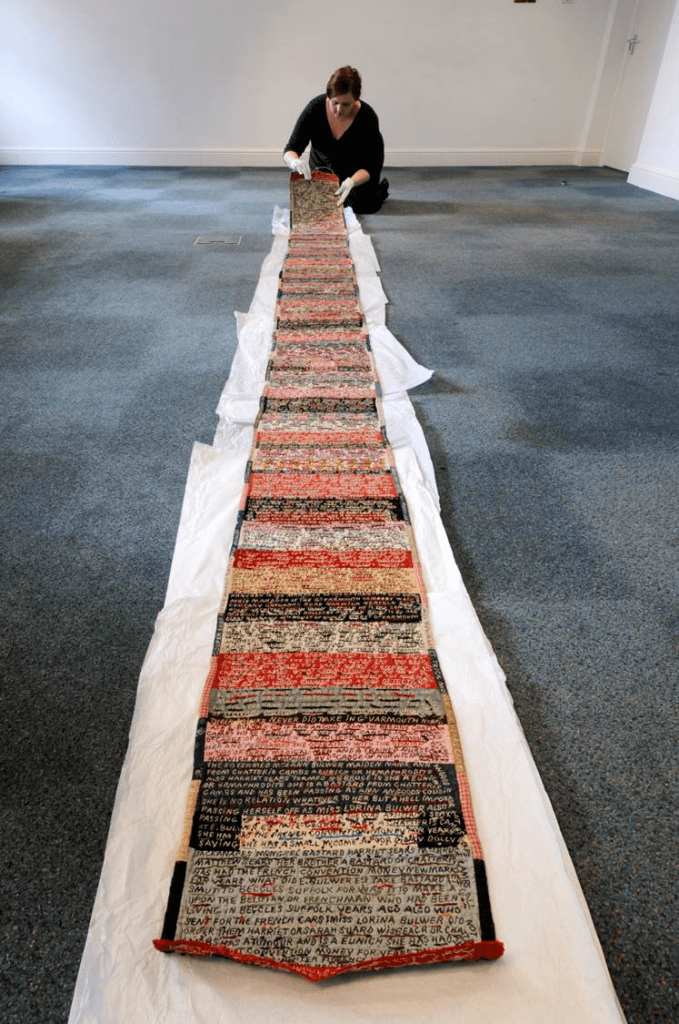
Fig 2 Shoddy Exhibition
Lorina Bulwer was an English woman who lived during the Victorian era and is remembered today not through conventional records or fame, but through a series of extraordinary, emotionally charged embroidered samplers. Created during her confinement in a workhouse in Great Yarmouth, Norfolk, her needlework pieces offer a rare, raw window into the lived experience of a marginalised woman in 19th-century England. These works have since been recognised as powerful examples of outsider art and proto-feminist expression.
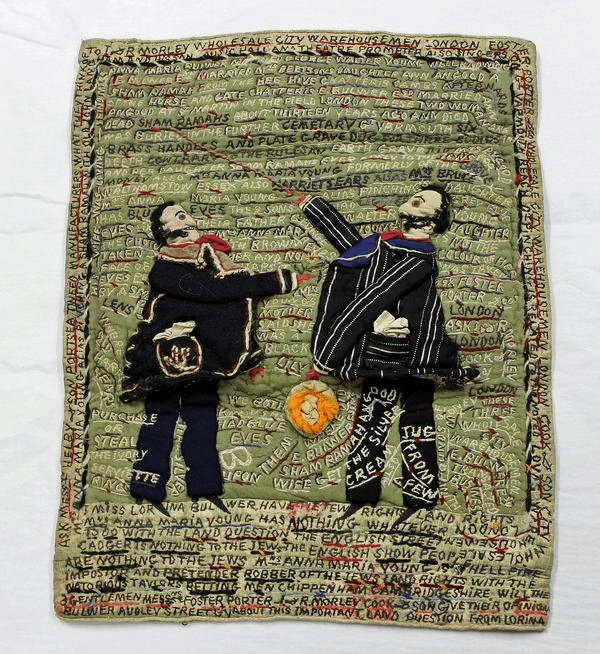
Fig 3 Embroidery; small panel of patchwork with stitched text made by Lorina Bulwer which includes two male figures facing each other and stitched upper case text surrounding them. At the time of stitching the work, Lorina Bulwer was resident in the female lunatic ward of Great Yarmouth workhouse.
A Life in the Shadows
Little is known about Lorina Bulwer’s early life. She was born in 1838 in East Anglia, into a relatively ordinary family. Her later years, however, were marked by significant personal tragedy and institutionalisation. After the death of her father and possibly a period of deteriorating mental health, Lorina Bulwer was committed to the Great Yarmouth Workhouse sometime around 1893. She remained there until her death in 1912.
The workhouse was a grim place for many, often serving as a last resort for the poor, elderly, or those deemed mentally unfit. For Lorina Bulwer, it became both a prison and a canvas.
The Embroidered Letters
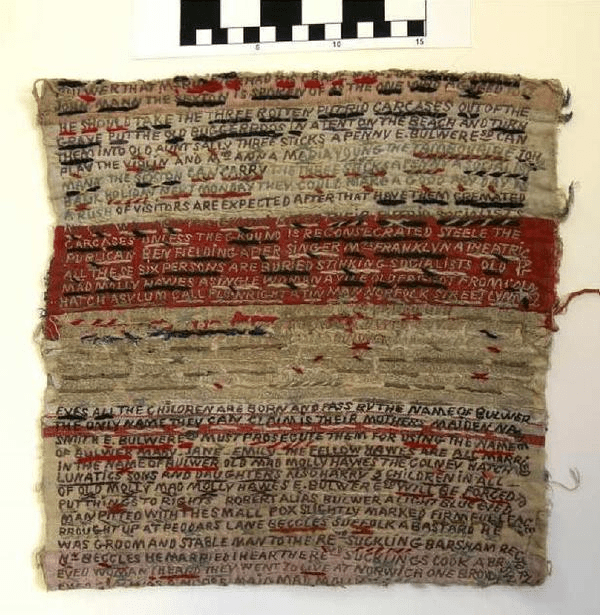
Fig 4 Faded section of sampler by Lorina Bulwer. This section is all that remains of a much larger sampler, and shows evidence of being cut around the edges. It is almost certain that Lorina Bulwer stitched this sampler whilst resident in the female lunatic ward of Great Yarmouth Workhouse between c.1901 – 1912. The sampler takes the form of an embroidered letter, and makes references to family members and individuals throughout.
It was during her time in the workhouse that Lorina Bulwer created her now-famous samplers—long, narrow scrolls of fabric densely packed with hand-stitched, uppercase text. They are angry, accusatory, sometimes nonsensical, and deeply personal. Each scroll—some as long as 12 feet—reads like a stream-of-consciousness letter or diary, capturing her outrage, sorrow, and bitterness.
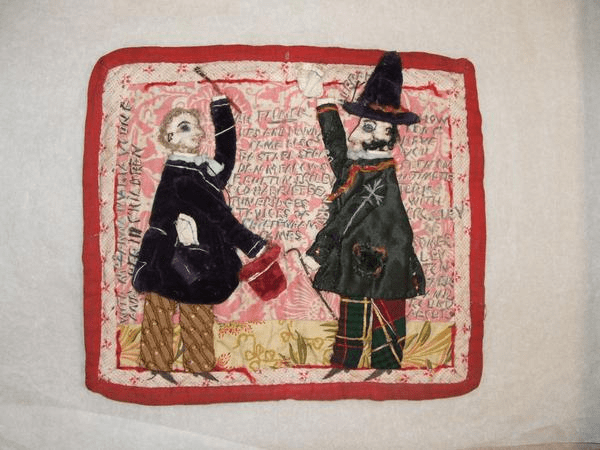
Fig 5 Small, square embroidered panel featuring hand-stitched words, and two male figures appliquéd in the centre. It was made by Lorina Bulwer who was probably in the Female Lunatic Ward Great Yarmouth Workhouse at the time, she was a resident there from around 1897 until her death in 1912. The embroidered text makes reference to Anna-Maria Young and her III children, this is Lorina Bulwer’s sister who is also mentioned frequently on other embroideries by Lorina Bulwer.
She frequently rails against her family, the authorities, and society at large. Phrases like “I AM LORINA BULWER,” “I WAS PUT IN THE WORKHOUSE,” and accusations of abuse and illegitimacy recur throughout her needlework. The tone is urgent and confrontational. She names people—possibly real, possibly imagined—with accusations of terrible deeds, including incest and betrayal. At times, the tone veers into what might be seen as delusional or paranoid, but at its core is an undeniable need to be seen and heard.
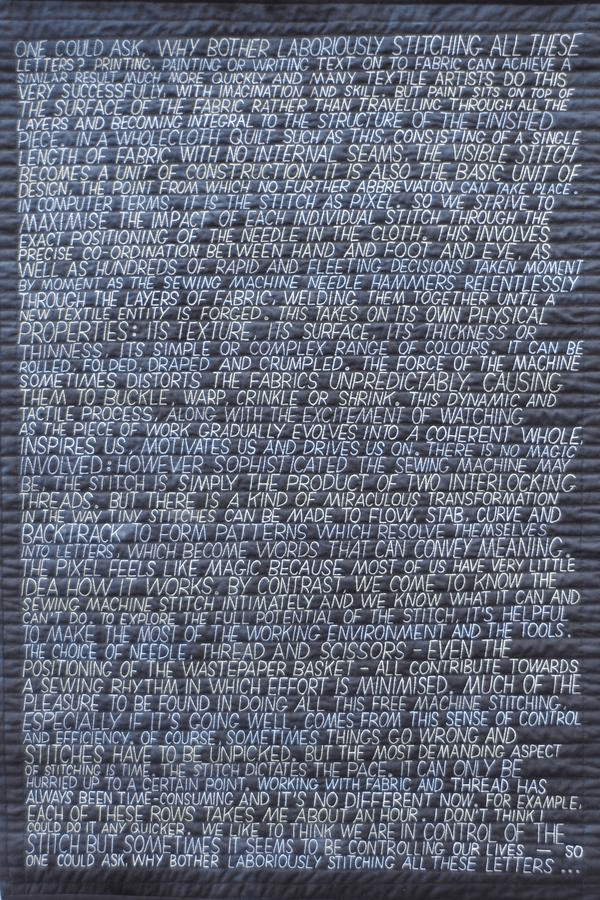
Fig 6 Quilt; hand dyed whole cloth quilt with text, machine quilted made by artist Sara Impey; ‘Stitch Talk.’ This work was inspired by samplers made by Lorina Bulwer and Elizabeth Parker. The whole surface of this work is covered with stitched lettering using the sewing machine and no other decorative features. The lettering is free-machine embroidered, the text was written by the artist as it was made and consists of meditations on the nature of stitch and stitched text. There are 524 words and a total of 51 lines of stitched text.
These samplers are not traditional embroidery meant for display or decoration. Instead, they are visceral, almost textual screams stitched with thread. The act of embroidery—typically a domestic, feminine craft—becomes, in Lorina Bulwer’s hands, a medium of protest and a lifeline of expression.
Rediscovery and Legacy
Lorina Bulwer’s work was discovered in the 20th century and has since drawn significant attention from historians, curators, and art critics. Her samplers are now part of the collection at the Norwich Castle Museum, where they are preserved and studied as important artifacts of both mental health history and outsider art.
She is often compared to other outsider artists—individuals who, often working in isolation and outside the mainstream art world, produce compelling and original work that speaks deeply to human experience. In Lorina’s case, her embroidery bridges the gap between craft, art, and autobiography.
Her samplers are now also being explored as early forms of feminist expression. In a time when women, especially those in asylums or workhouses, were voiceless and invisible, Lorina Bulwer literally stitched her story into history.
Conclusion
Lorina Bulwer may have died alone and marginalised, but her words—stitched in fury, grief, and resilience—endure. In an era when mental illness was poorly understood and women’s voices were routinely silenced, Bulwer’s embroidery stands as an act of resistance. Her work continues to captivate audiences and scholars, reminding us of the power of art to preserve humanity, even in the bleakest circumstances.
Her samplers are more than fabric and thread; they are testimony. And in the stitched scream of Lorina Bulwer, we hear the echo of countless forgotten voices.
References:
Image Credits:
Fig 1 East Anglian Stitch Textiles
Fig 2 Shoddy Exhibition
Fig 3 Norfolk Museum Collection
Fig 4 Norfolk Museum
Fig 5 Norfolk Museum
Fig 6 Norfolk Museum
Websites:
 Rachel Bakewell

