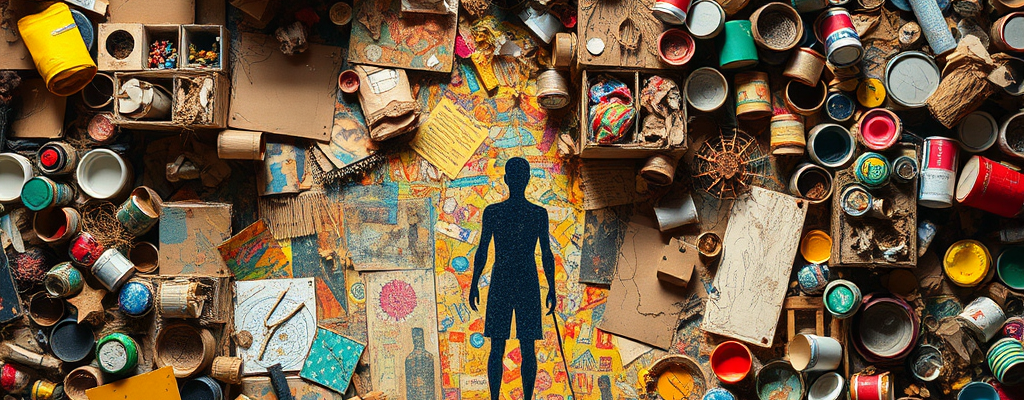
Outsider art refers to work created outside the boundaries of traditional or mainstream culture—art that springs from raw, untrained, and often deeply personal expression. It is made by individuals who typically have no formal artistic education and who exist outside the established art world due to mental illness, isolation, poverty, or a conscious rejection of societal norms. The term, often used interchangeably with art brut (raw art), represents a powerful challenge to conventional definitions of art and artistic legitimacy.
Origins of the Term
The concept of outsider art was first championed by French artist Jean Dubuffet in the 1940s. He coined the term art brut to describe art made by people on the margins—particularly psychiatric patients and recluses—whose works he believed were more authentic and untamed than those produced by professional artists shaped by education and cultural expectations.
In 1972, British art historian Roger Cardinal introduced the English equivalent, “outsider art,” broadening the term to include a wider array of self-taught and unconventional artists.
Characteristics of Outsider Art
Outsider art is not defined by a specific style or medium but rather by the context and mindset of its creators. Still, several key characteristics recur:
- Self-Taught Vision: Outsider artists often have no formal art training. Their techniques and methods are developed independently, leading to highly original and unconventional works.
- Intense Personal Expression: Many outsider works are deeply autobiographical, spiritual, or fantastical. They reflect inner worlds that are rarely accessible through mainstream culture.
- Unconventional Materials: Outsider artists frequently use found or repurposed objects—bottle caps, scrap wood, cardboard, textiles—out of necessity or choice.
- Isolation: The artists may be socially isolated due to mental illness, neurodivergence, incarceration, poverty, or their own intentional withdrawal from society.
Iconic Outsider Artists
Some of the most revered outsider artists have emerged from obscurity to posthumous fame:
- Henry Darger: A recluse who spent decades secretly creating a 15,000-page fantasy manuscript and hundreds of watercolour illustrations, discovered only after his death.
- Martin Ramirez: A Mexican-American who spent much of his life institutionalised for schizophrenia, creating intricate drawings from scraps and homemade glue.
- Judith Scott: Born with Down syndrome and deafness, she became internationally celebrated for her intricate fibre sculptures created at the Creative Growth Art Centre in Oakland.
- Howard Finster: A Baptist minister from Georgia whose religious visions inspired thousands of paintings and a folk-art environment known as Paradise Garden.
Outsider Art and the Art World
While outsider art was once dismissed or exoticised, today it occupies a recognised and growing place in museums, galleries, and art fairs. Institutions like the American Folk Art Museum in New York and the Collection de l’Art Brut in Lausanne, Switzerland, are devoted to preserving and showcasing this work.
However, as outsider art becomes more visible and commercialised, it raises questions about categorisation and power. Who decides what counts as “outsider“? Can an artist remain “outside” once they are embraced by the mainstream? Critics argue that the label, while useful, risks romanticising suffering or reinforcing the notion that these artists are “other.”
Outsider Art as a Human Expression
At its heart, outsider art is about unfiltered creativity. It speaks to a human impulse to make sense of the world—sometimes as a form of therapy, sometimes as spiritual expression, and often as a vital means of communication. Whether created in an attic, an asylum, or a backyard, outsider art bypasses theory and tradition to connect directly with emotion and imagination.
Conclusion
Outsider art defies categorisation and challenges our assumptions about what art should be, who gets to make it, and where it comes from. It serves as a potent reminder that creativity is not confined to museums or institutions—it lives in anyone with the need and will to express. In embracing outsider art, we open ourselves to the raw, strange, and deeply human corners of artistic expression—and in doing so, we expand our understanding of art itself.
References:
Websites:
Henry Darger Alchetron
Martin Ramirez The Keen Collection MuseoCJV
Judith Scott Creative Growth Art Centre
 Rachel Bakewell