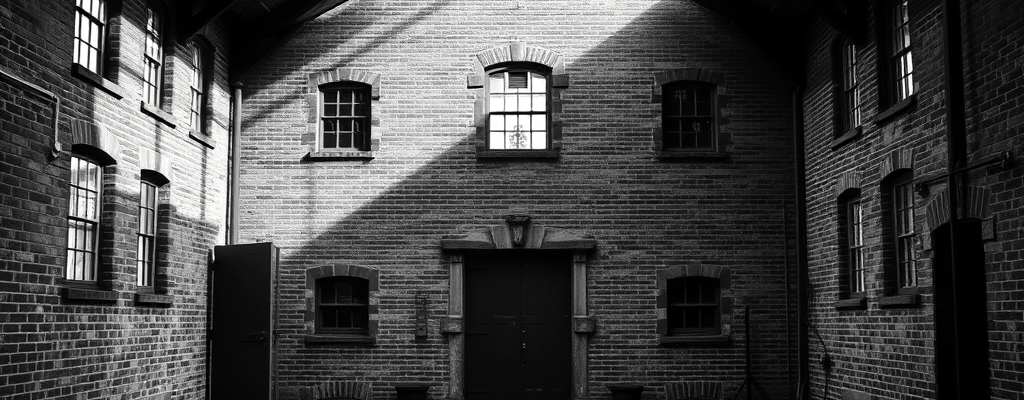
While workhouses were widespread across 19th-century Britain, each had its own unique history, shaped by the local economy, population, and industrial development. The Ashton-under-Lyne Union Workhouse, which served Gee Cross and the surrounding areas of Greater Manchester, was a prime example of how these institutions evolved alongside Britain’s textile-driven industrial age.
From Fletcher Street to Fountain Street: Expansion and Reform
The first known poor relief facility in Ashton operated on Fletcher Street from 1730 until 1851. This original parish workhouse was modest—housing around 64 inmates in the late 1700s. But as Ashton became a booming textile town, the growing population and rising poverty levels overwhelmed this facility.
In 1851, a more ambitious structure—the Ashton-under-Lyne Union Workhouse—was built on Fountain Street, designed to accommodate up to 500 people. Over time, it expanded with hospital blocks, laundries, and kitchens, mirroring the industrial efficiency and social stratification of the era.
Workhouse Labour and the Textile Connection
In a region dominated by cotton mills, textile labour naturally extended into the workhouse. Though the poorest citizens were excluded from the booming profits of industrial Ashton, they were still entangled in its machinery—sometimes literally.
Laundry and Sewing
By 1880, the workhouse featured steam laundries, where women and older girls worked long hours cleaning institutional linen. The tasks were physically demanding and often unsafe, especially around boilers and wringers. These laundries sometimes served local hospitals or public contracts, effectively turning the workhouse into a commercial laundry—without paying its workers.
Sewing and mending were also core tasks for female inmates. Women repaired worn garments, stitched uniforms, and sometimes produced shrouds for the deceased. This invisible labour supported the smooth running of the institution and reflected gendered expectations of silent, obedient work.
Textile Workers Among the Inmates
The 1881 census for Ashton’s workhouse recorded a mix of people: factory workers, hawkers, widows, disabled individuals, and others left behind by the rapid march of industrialisation. Some had once worked in mills or garment shops—discarded by injury, illness, or the relentless demands of factory life.
Human Stories Behind the Walls
Though records are sparse, some personal stories hint at the lives behind the statistics.
- Mill Widow Turned Inmate: In census returns, we find women listed as former “cotton weavers” or “spinners” who ended up in the workhouse after being widowed or disabled. With little or no family support, many had no choice but to enter the system.
- Child Labour and Training: Children in the Ashton workhouse were often trained for domestic service or low-skilled mill work. Girls were taught needlework from a young age, sometimes producing samplers—an eerie echo of middle-class embroidery, but done out of duty rather than leisure.
- The Silent Stitches of the Infirmary: Hospital blocks added to the workhouse in later years became places where inmates, especially women, sewed not for pay or pride, but to pass time, relieve stress, or in some cases, to express grief and memory. Some textile historians speculate that inmates may have secretly created keepsakes or stitched initials into cloth—small acts of identity in a place built to erase it.
From Workhouse to Hospital: A Legacy Reconsidered
The Ashton Union Workhouse was formally abolished in 1930, following the dissolution of the Poor Law system. However, the building remained active under different guises. It was absorbed into the public healthcare system and became part of what is now Tameside Hospital.
Remarkably, the building continued to serve the public until 2007, when it was finally decommissioned. Today, a heritage plaque marks the site—an acknowledgment of the thousands who lived, worked, suffered, and stitched within its walls.
Are Your Threads Tied to the Workhouse?
If you have ancestors from Ashton-under-Lyne, Stalybridge, Hyde, or Gee Cross, there’s a real chance they may have passed through the Fountain Street workhouse. Archival resources—including census records, Poor Law Union minute books, admission registers, and infirmary logs—can be incredibly revealing.
In Closing: The Fabric of Forgotten Lives
The Ashton-under-Lyne Workhouse tells a story not just of poverty and punishment, but of resilience, labour, and lost voices—many of them stitched quietly into sheets, uniforms, or laundry baskets. In remembering this history, we honour the lives that helped shape our communities—even from society’s margins.
References:
Websites:
 Rachel Bakewell