
Artist: George Frederic Watts
Date: Circa 1848–1850
Medium: Oil on canvas
Location: Tate Britain, London
Dimensions: 864 × 508 mm
About the Painting
Found Drowned portrays the lifeless body of a young woman washed up under a bridge in the River Thames. The setting is dark and desolate. The figure lies draped in wet, clinging fabric. A faint city light glimmers in the background, but there’s no comfort here, only silence and sorrow.
The composition is heavily influenced by Christian iconography; the figure recalls a pietà, the Virgin Mary cradling the dead Christ. This gives the anonymous woman an aura of tragic sanctity, suggesting she is a victim of a society that failed her.
If you’re curious about the meaning of “pietà,” you’ll find a brief explanation below:
“Pietà” is an Italian word that means “pity” or “compassion”, in art Pietà, refers to a deeply emotional scene: the Virgin Mary cradling the lifeless body of Jesus after his crucifixion for example. It’s a powerful symbol of sorrow, tenderness, and maternal love, often captured in sculpture or painting.
The most famous example is Michelangelo’s Pietà in St. Peter’s Basilica, sculpted when he was just 24. It’s breathtaking not just for its technical mastery, but for how it conveys grief with such grace and stillness — Mary’s face serene, her arms open, holding the weight of loss and love all at once.
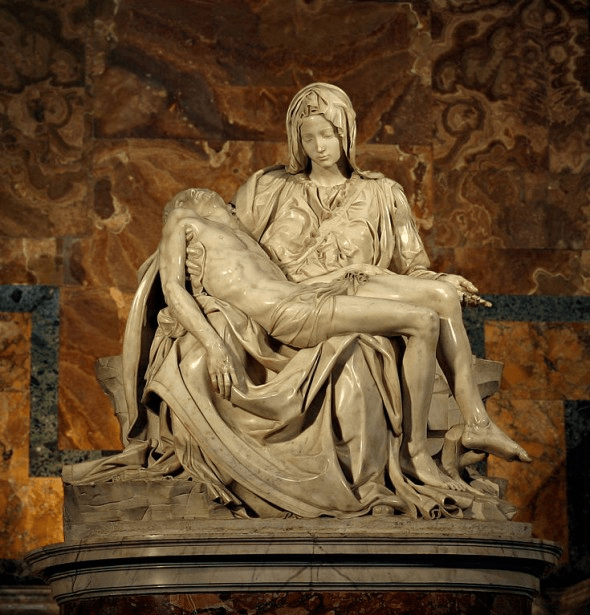
Michelangelo, Pieta, c. 1498-1500, marble
It’s one of those images that stays with you, not just religiously, but emotionally.
Context & Meaning
The work Found Drowned is a response to the social consequences of urban poverty, particularly for women. It was likely inspired by Thomas Hood’s poem “The Bridge of Sighs” (1844), which tells of a “fallen” woman—possibly a servant, factory worker, or unmarried mother, who, is facing social shame and economic ruin, takes her own life by drowning in the Thames.
Victorian society often ostracised women who strayed from their strict moral codes, especially those involved in sex work, or who had children out of wedlock. Suicide among such women was tragically common. George Frederic Watts doesn’t judge his subject; instead, he paints her with compassion and reverence.
“Make no deep scrutiny
Into her mutiny
Rash and undutiful:
Past all dishonour,
Death has left on her
Only the beautiful.”
— Thomas Hood, “The Bridge of Sighs” (1844)
Connection to Textile History & Women’s Labour
Found Drowned resonates powerfully with other Victorian representations of women’s labour and suffering, like The Song of the Shirt and the wider conditions of seamstresses and needleworkers. These women, often overworked and underpaid, lived on the margins of respectability. If they lost their jobs or fell ill, many had no safety net.
Watts, like some of his contemporaries, used art as a form of social critique, showing the human cost of Britain’s industrial success and rigid moral expectations. His work can be seen as a visual protest, urging compassion and reform.
Legacy and Relevance
Watts considered Found Drowned as a “social painting,” and it still speaks to viewers today. It echoes questions about how society treats its most vulnerable, particularly women who are cast aside or blamed for their own poverty or exploitation.
The painting is often discussed in exhibitions and scholarship around:
- Victorian social realism
- Women and mental health
- Morality and visual storytelling
- The symbolism of the Thames in literature and art
Further Reading
- George Frederic Watts: Victorian Visionary – exhibition catalog, Watts Gallery & Tate
- The Subversive Stitch by Rozsika Parker – includes feminist readings of Victorian art and craft
- Women Work and Representation Needlewomen Victoian Art and Literature by Lynn M. Alexander
- Thomas Hood’s “The Bridge of Sighs” (1844) Key to Poetry
References:
Image:
Websites:
 Rachel Bakewell