(Disclaimer below)
Growing up in a country where Catholicism is deeply embedded in both public life and private rituals, it’s almost impossible not to be shaped—visually, emotionally, and culturally—by its symbolism. From childhood baptisms to funeral masses, the Catholic imagination permeates everyday life in ways both subtle and profound. For many artists, including myself and those I admire like Geraldine Javier, these symbols are not just religious icons—they are cultural artifacts loaded with memory, contradiction, and emotional complexity.
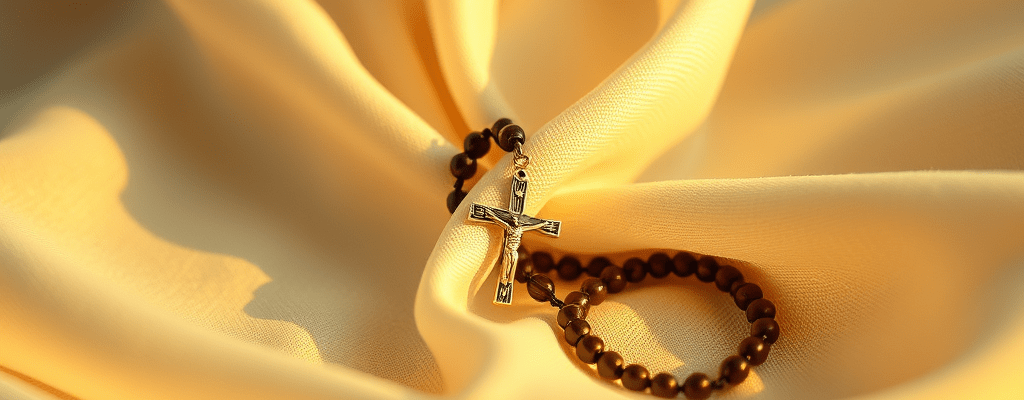
The crucifix, for instance, is perhaps one of the most charged symbols in Catholicism. It is not only a reminder of sacrifice and suffering but also of endurance and redemption. The bleeding heart of Jesus, the rosary, the Virgin Mary crowned in gold—these images, steeped in centuries of ritual and doctrine, carry both comfort and heaviness. In art, they can evoke reverence, but also provoke questions, especially when placed in secular or hybrid contexts.
Art historians such as David Morgan (Visual Piety: A History and Theory of Popular Religious Images, 1998), (Limited Preview) have explored how Catholic imagery extends beyond the church into domestic spaces, where it becomes part of daily devotion and identity.
For many contemporary Southeast Asian artists, Catholic symbolism intersects with colonial history and Western influence. Artists like Geraldine Javier engage with these symbols not as declarations of faith, but as deeply personal materials—both to reckon with the past and to search for meaning beyond the confines of organised religion. In her works, stitched veils, botanical elements, and traces of Catholic icons speak of a more universal spirituality, one filtered through personal loss, cultural memory, and resistance.
As someone raised around these symbols, I often feel both drawn to and unsettled by them. Their beauty is undeniable, but so is their power to shape narratives of guilt, devotion, and control. Exploring Catholic symbolism through art gives me a way to unpack those feelings—to see them not as static icons, but as living, evolving languages that can still speak to our present moment.
Disclaimer:
This post reflects personal reflections and artistic interpretations related to Catholic symbolism. It is not intended to criticise or diminish anyone’s faith or religious practice. My intention is to explore the cultural and emotional impact of these symbols through an artistic and reflective lens. I fully respect the diversity of belief and experience within and beyond the Catholic tradition.
Further Reading & Resources:
Visual Piety: A History and Theory of Popular Religious Images by David Morgan (Limited Preview).

Cover Resurreccion, (unsigned), circa 18th century, molave. Image taken from Tatler Asia article
All references are used respectfully for educational storytelling. See About Me for full source credits.
Subscribe for fresh posts on art, poetry, and thoughtful storytelling — delivered with care.
 Rachel Bakewell