When we think of the suffragette movement, we often picture marches, protests, and prison hunger strikes. But behind the headlines was a hidden world of secret operations, coded messages, and daring escapes. The suffragettes were not just campaigners — they were masters of subterfuge. Their underground tactics rival any spy novel, complete with disguises, safe houses, and escape missions that defied the law and public expectations.
Disguises & Decoys
To outwit the police, suffragettes turned to costume and deception. Surveillance was constant, so blending in was essential.
- Activists disguised themselves as chorus girls, nurses, errand boys, and even elderly women to move undetected.
- They adopted aliases, used coded messages, and employed lookouts and decoys to mislead authorities.
- Some wore corrugated cardboard up their sleeves — a clever form of DIY armour to prevent bruising when police grabbed their arms during arrests.
Safe Houses & Secret Headquarters
Behind closed doors, homes across Britain became nerve centres of the suffragette resistance.
- One of the most famous was Mouse Castle in Campden Hill Square, owned by Mrs Hilda Eliza Brackenbury, who was herself arrested at the age of 79.
- The WSPU even rented a house opposite Holloway Prison, using megaphones and hand signals to communicate with imprisoned suffragettes.
- Escape operations were often staged in broad daylight, with decoys used to distract police while the real activist made a quiet getaway.
The Bodyguard Unit
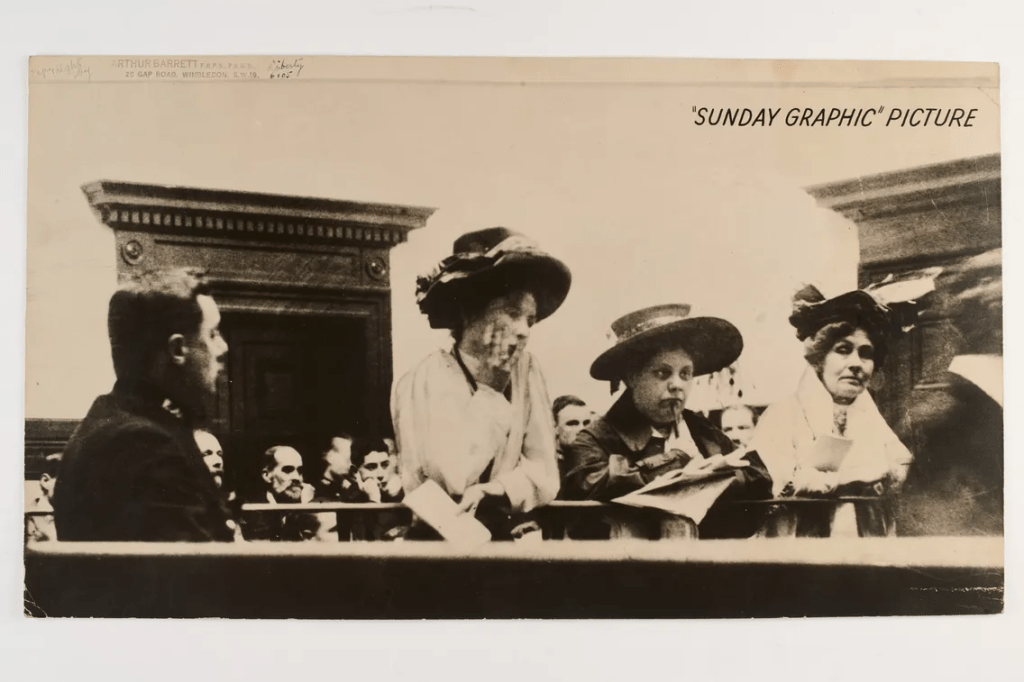
Fig 1: Emmaline & Christabel Pankhurst and Flora Drummond in the dock of Bow Street Magistrates Court, 1908 Image Source: London Museum
Formed to protect leaders like Emmeline Pankhurst, this elite secret group of women was trained in jujitsu and equipped for extraction missions.
- Known simply as “The Bodyguard”, they acted as security at rallies and during high-risk appearances.
- Their gear? Improvised at times — cardboard padding for protection and wooden clubs hidden under cloaks.
- Their motto? Be ready to fight back, defend each other, and never let a leader fall into police hands without a struggle.
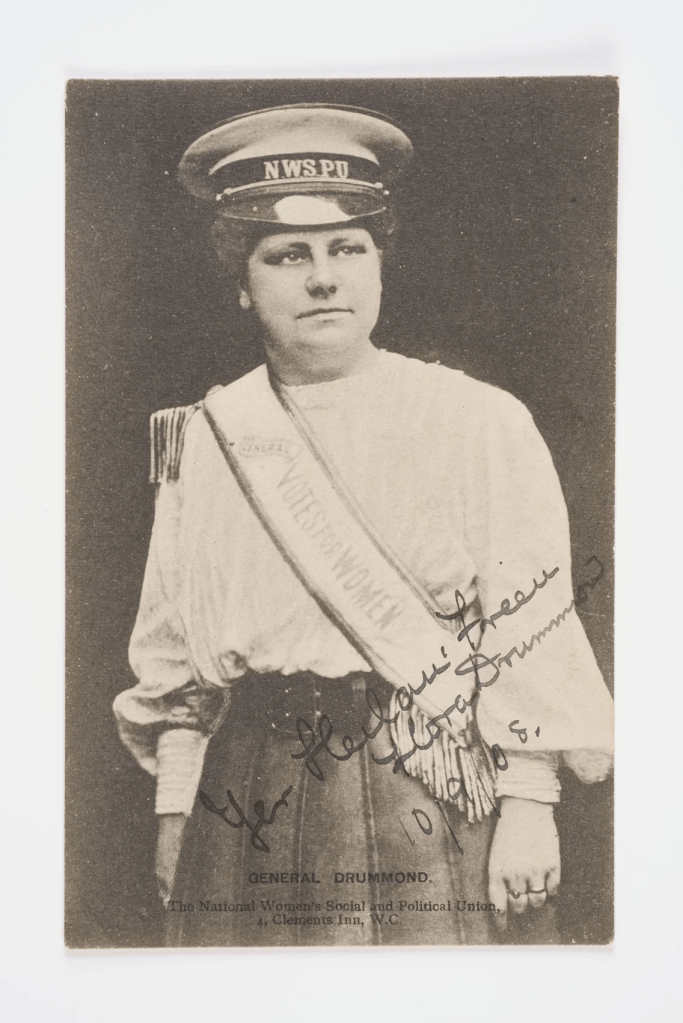
Fig 2: A signed postcard, with a portrait of Flora Drummond (1879-1949). Beneath is printed ‘General Drummond’. Image Source London Museum
The Great Disguise Escape: Lilian Lenton, the “Leicester Pimpernel”
One of the most legendary stories of suffragette espionage stars Lilian Lenton, a fiery activist who became infamous for her role in the WSPU’s arson campaign.
In 1913, after being arrested for setting fire to the Tea Pavilion at Kew Gardens, Lilian was force-fed in prison — and fell seriously ill with pleurisy. Under the controversial Cat and Mouse Act, she was released to recover, with police waiting to re-arrest her once she regained strength.
But Lilian had other plans.
The Errand Boy Switch
While hiding in a safe house in Leeds, police surrounded the building. That’s when the suffragette network jumped into action:
- A fellow activist disguised herself as an errand boy, apple in hand and cap pulled low.
- She entered the house through the back door.
- Moments later, “the errand boy” emerged again — but this time, it was Lilian in disguise.
- She slipped into a waiting car and vanished, long before the police realised they’d been tricked.
Lilian’s escape became the stuff of legend. She later claimed she intended to burn two houses a week as part of her campaign for women’s suffrage.
Legacy of Resistance
The suffragettes knew that visibility was power — but invisibility was strategy. Their covert operations revealed a movement as cunning as it was courageous. From disguises and decoys to safe houses and secret signals, these women turned domestic spaces into war rooms and everyday clothing into tools of rebellion.
Their stories remind us that the fight for their rights has always required creativity, boldness — and more than a little bit of subterfuge.
Further Reading:
Secret Missions of the Suffragettes – Glass Breakers & Safe Houses, Historical Writers’ Association.
The Forgotten Suffragettes & Tales of Militancy-The London Museum
References:
Images:
Fig 1: London Museum
Fig 2: London Museum
 Rachel Bakewell