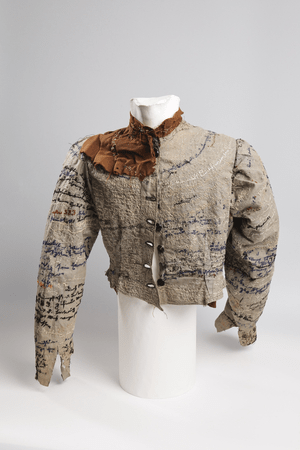
Richter, Agnes. Handmade jacket embroidered with autobiographical text, 1895. Prinzhorn Collection, Heidelberg University Hospital, Inv. No. 743. Discussed in Rosner, Isabella. “I plunge headlong into disaster: Unstitching Agnes Richter’s Jacket.” The Polyphony, 2 September 2021.
Although Agnes Richter herself was not from the UK—she lived in Germany during the late 19th century—I felt her story and work would be of interest here. The jacket transcends national boundaries; it speaks to universal themes of voice, identity, and resilience in the face of institutional control. In many ways, Agnes Richter’s embroidered diary resonates far beyond its historical and geographical origins, offering a deeply human connection that art lovers, historians, and readers everywhere can appreciate.
In the late 19th century, Agnes Richter, a seamstress from Dresden, was institutionalised in a psychiatric hospital. While confined, she transformed a simple patient’s uniform into something extraordinary: a hand-stitched jacket densely embroidered with her own words.
The jacket, now housed at the Prinzhorn Collection in Heidelberg, is far more than an article of clothing—it is a personal diary, an act of resistance, and a work of art. Agnes Richter’s sentences, sewn into the fabric in tiny, near-illegible script, speak to her identity, her life before incarceration, and her experience within the institution. Although much of the text remains partially deciphered, fragments convey longing, defiance, and self-assertion, such as references to her own name, personal memories, and cryptic affirmations.
The Jacket as Testimony
Agnes Richter’s embroidery was not mere decoration—it was a narrative. She literally wore her story on her body, defying the silencing structures of the asylum. In an environment where patients were often stripped of personal possessions, the jacket became a portable archive of her inner life. The layered stitching, overlaps, and deliberate repetitions suggest a compulsion to record, perhaps even to protect memories from erasure.
Art historians and psychiatric historians alike have interpreted the jacket as a deeply embodied form of autobiography, created under conditions where written records might have been censored, confiscated, or destroyed. In this sense, it operates both as a protective garment and as a subversive manuscript.
Preservation and Interpretation
Since its rediscovery, Agnes Richter’s jacket has been studied alongside other works in the Prinzhorn Collection—an archive of art made by psychiatric patients in German institutions between 1880 and 1920. Scholars continue to debate whether the work was primarily therapeutic, artistic, or political. What’s clear is that it stands as a rare example of a woman in an asylum articulating her subjectivity in a medium that blurred the boundaries between clothing, art, and text.
Further Reading & References
- MacGregor, John. The Discovery of the Art of the Insane. Princeton University Press, 1989.
- Prinzhorn, Hans. Artistry of the Mentally Ill: A Contribution to the Psychology and Psychopathology of Configuration. Springer-Verlag, 1972.
- Hornstein, Gail A. Agnes’s Jacket: A Psychologist’s Search for the Meanings of Madness. Rodale, 2009.
- Didi-Huberman, Georges. Invention of Hysteria: Charcot and the Photographic Iconography of the Salpêtrière. MIT Press, 2003 (for contextual discussions on representation of patients).
References:
Websites:
 Rachel Bakewell