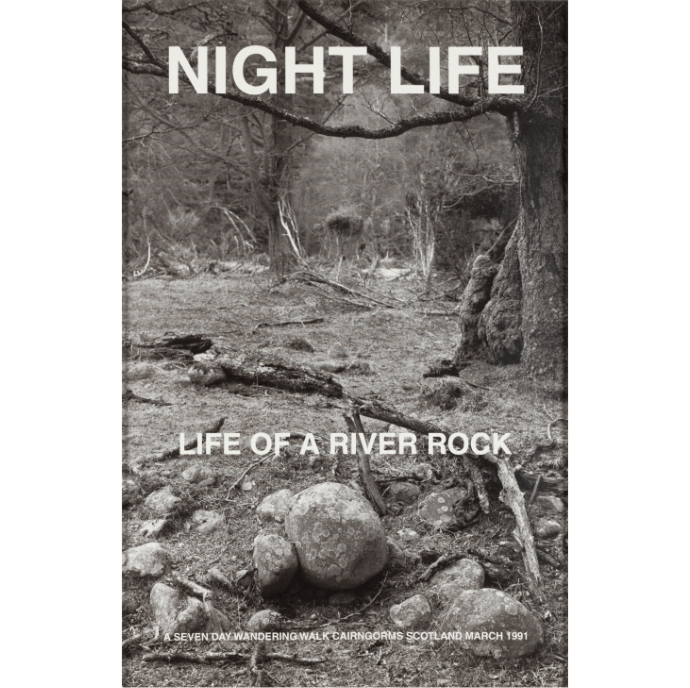
Hamish Fulton, Night Life, 1993
Screenprint from the portfolio Ten Toes Towards the Rainbow
Government Art Collection, UK
https://artcollection.dcms.gov.uk/object/17729-1/
British artist Hamish Fulton (b. 1946) is often described as a “walking artist.” For more than five decades, he has devoted his practice to the act of walking—not simply as a means of moving through the world, but as an art form in itself. Unlike land artists who alter the landscape with interventions, Hamish Fulton leaves no physical trace on the land. Instead, the walk itself is the artwork, with photographs, texts, and drawings serving as records of the experience.
Walking as a Creative Act
Since the early 1970s, Hamish Fulton has committed to the principle that “a walk has a life of its own and does not need to be materialised into an artwork.” His practice emphasises the physical, spiritual, and ecological dimensions of walking. Each journey—whether across mountain ranges, deserts, or urban spaces—is shaped by duration, weather, rhythm, and terrain.
Hamish Fulton often undertakes solo walks, but he also organises group walks, where participants collectively experience the act of moving through space with heightened awareness. These shared walks transform a simple activity into a meditative, communal artwork.
Beyond Land Art
Although associated with Land Art of the 1960s and 70s, Hamish Fulton’s approach is distinct. Where artists like Richard Long create visible interventions—lines of stones, paths traced in grass—Hamish Fulton’s philosophy is “leave no trace.” His work reflects a deep ecological respect: walking as witness rather than imposition.
Words and Images as Records
The visual works Hamish Fulton produces, photographs, wall texts, and artist books—they aren’t the art itself but poetic residues of the walk. A simple phrase, a date, or a place name can evoke an entire journey. Bold typography and minimal imagery hint at the experience without attempting to fully capture it, leaving space for the viewer’s imagination.
Environmental and Spiritual Dimensions
Hamish Fulton’s practice resonates strongly today, as walking becomes both a mindful escape and an ecological statement. His walks are acts of alignment with nature, emphasising slowness in a culture of speed. They invite reflection on how humans inhabit the earth without consuming or altering it.
Why Hamish Fulton Matters
Hamish Fulton reminds us that art is not always an object; it can be an action, a rhythm, a way of moving through the world. By framing walking as art, he expands our sense of what creativity can be—simple, ephemeral, and profoundly connected to the land.
In Hamish Fulton’s world, every step is art, and every journey a quiet act of resistance against speed, consumption, and disconnection.
FURTHER READING:
- Tate – Artist Page
Includes a selection of works in their collection, biographical notes, and insights into his walking-based practice. - National Galleries of Scotland
Provides context on his conceptual roots, connection to land art, and his approach to documenting walks through photography and text.
References:
Image Credit: The Government Art Collection
 Rachel Bakewell