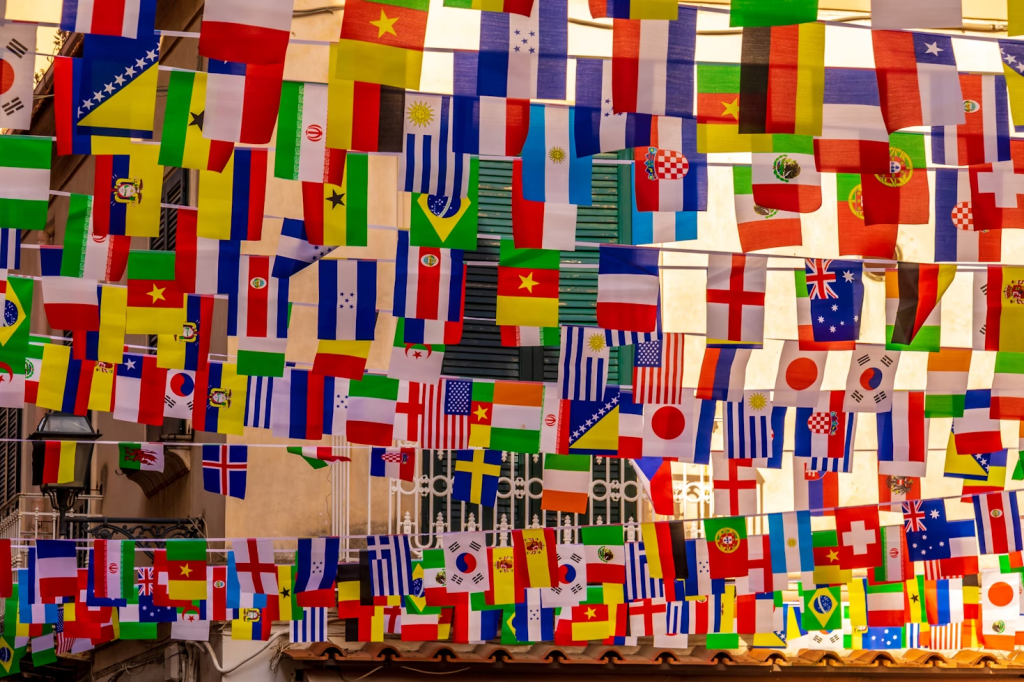
Image Credit: Photo by Nick Fewings on Unsplash
“Flags are not just symbols—they are textiles of memory. Woven, stitched, dyed, and flown, they carry the weight of collective identity and the quiet resonance of personal meaning. For nations, flags declare sovereignty. For communities, they signal solidarity. For individuals, they often evoke longing, pride, or protest.”
A History Woven in Cloth
Historically, flags emerged from cloth—banners carried into battle, standards raised in ceremony, motifs embroidered with reverence. Ancient civilisations like Egypt and Rome used flag-like emblems to rally troops and mark territories. The materials mattered: silk for prestige, wool for resilience, linen for clarity. The act of making a flag was often communal, ceremonial, and deeply emotional.
As societies evolved, so did flags. They became tools of communication, expressions of autonomy, and visual shorthand for complex histories. In modern times, flags are raised in mourning, lowered in respect, folded in honour. They are stitched into uniforms, printed on passports, waved at protests.
Cultural Identity and Emotional Resonance
Flags encapsulate the essence of nations and communities. The choice of colours, symbols, and patterns speaks volumes about the cultural heritage they represent. The Welsh dragon nods to medieval legend; India’s tri-colour reflects religious and cultural diversity; the keffiyeh, often worn as a scarf, has become a flag-like emblem of resistance and remembrance.
In regions striving for autonomy, flags become potent tools of expression. Catalonia’s yellow and red stripes, for instance, reflect centuries of cultural and political yearning. Many indigenous designs, tribal flags, or diaspora flags carry layers of ancestry, geographical memory, and resilience.
Flags are worn, waved, and displayed—in doing so, they animate identity.
Flags as Emotional Documentation and Materiality
Flags are needed not just for recognition but for ritual. They become part of civic life—and of personal reflection. What colours do we choose to represent us? What symbols feel true? What textures carry our past?
In this way, flags are not just national emblems. They are quiet witnesses to history, stitched with care and flown with feeling. The materiality matters—the weight of fabric, how the edges fray over time, how the dye holds or fades. These are not minor details; they are part of the story.
When Flags Become Contested, Painful, or Negative
- Flags are often seen as unifying, but in many cases they are deeply contested. The same textile that lifts hearts can also wound. Here are some examples and dynamics of when flags carry negative or divisive meanings:
- Equality court: Flying old SA flag is hate speech: This article covered the ruling in depth, noting that the court found the flag’s dominant meaning to be a visual endorsement of racism and white supremacy. The judgment emphasised that even non-verbal gestures like waving a flag can amount to hate speech under the Equality Act. Mail & Guardian
- The Confederate battle flag in the U.S. similarly is a source of debate; some view it as a heritage, others as a symbol of slavery and racism. Academic work argues that the “heritage vs hate” framing is misleading, because the Confederate symbols were always rooted in the defense of slavery and white supremacy. Wiley Online Library
Political appropriation and shifting meaning: Flags can be re-interpreted, co-opted, or “recycled” with new associations. For instance, the paper: Old Flags, New Meanings (2022) documents how flags like the Gadsden Flag in the U.S. and the Eureka Flag in Australia have been adopted by different political movements, carrying connotations that differ from their original intent. eScholarship
Symbols of exclusion or threat. Flags can signal power or dominance in ways that make others feel subordinate or excluded. Research shows that symbols (flags included) can make groups look more unified and thus more threatening to others. Flags become visible cues in struggles over identity and belonging. PubMed
Negativity towards certain displays
There are surveys indicating that people sometimes view flying certain flags (or even national flags) negatively, depending on location, political context, or which flags are being used. For example, a YouGov survey in England found that while many people had favourable views of the England flag, about a quarter had unfavourable opinions of people flying it outside their homes, reflecting political tensions surrounding nationalism. YouGov
Flag desecration and protest
The act of desecrating a flag, (burning it, defacing it, etc.) is highly emotionally charged. In studies, people who feel strongly “blind patriotism” (i.e. uncritical loyalty to one’s nation) tend to respond with increased bias or hostility when a national flag is burned or disrespected. SpringerLink
Weaving Complexity: What Flags Teach Us
- Symbols are not fixed. The meaning of a flag shifts depending on who carries it, where, and when. What once symbolised independence may be used for exclusion; what was protest may become part of state power.
- Material aspects matter: how flags are displayed, who makes them, who waves them, what fabric, what place, what time—all of this influences how they are felt.
- Emotional reactions are real. Pride, longing, solidarity—but also fear, alienation, anger. Flags often carry both joy and pain. Recognising that duality helps us to understand public debate, protest, identity politics.
Closing Reflection
Flags are more than cloth. They are layers of memory, woven with hope and sometimes with grief. When we see a flag, we see stories: of patriotism and resistance, inclusion and exclusion, visible and invisible histories. In their folds live both pride and critique.
Is there a flag you feel personally connected to—one that stirs joy or perhaps a quiet ache? Part of what makes flags so compelling is how they move beyond mere symbols to carry deeply personal stories and emotions.
REFERENCES
Platoff, Anne M. & Knowlton, Steven A. Old Flags, New Meanings. 2022. eScholarship
Martinez, James Michael & Mary Christine Cagle. Reexamining Confederate symbols displayed on flags and monuments… Social Science Quarterly, 2022. Wiley Online Library
Shanafelt, Robert. The nature of flag power: How flags entail dominance, subordination, and social solidarity. Politics and the Life Sciences, May 2016. Cambridge University Press & Assessment
López Ortega, Alberto. The war on flags: Opposition to state-sponsored LGBTQ+ symbols. Research & Politics, 2024. SAGE Journals
Survey data: YouGov poll on attitudes toward flying the England flag. YouGov
Study: Don’t burn our flag: patriotism, perceived threat, and the impact of desecrating a national symbol… SpringerLink
Images:
 Rachel Bakewell