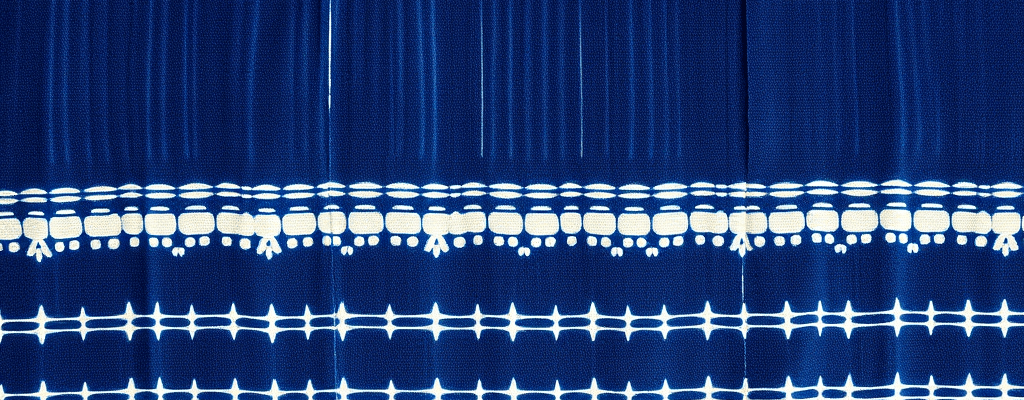
There’s a kind of thinking that happens through the hands — a dialogue between fabric, water, and intention. Shibori, the Japanese art of resist dyeing, is one of those languages. Each fold, stitch, bind, or twist shapes how indigo breathes across cloth — never fully controlled, always partly a conversation with chance.
Origins: A Craft of Restraint and Release
The word shiboru means “to wring, squeeze, or press.” The technique dates back more than 1,300 years in Japan, with early examples found in 8th-century temples like Tōdai-ji in Nara.
Historically, Shibori flourished among rural craftspeople who used it to transform plain hemp and cotton into patterned textiles. Later, during the Edo period (1603–1868), it became an art form associated with kimono making, particularly in regions such as Arimatsu and Narumi on the old Tōkaidō road — towns still known for their master dyers today.
(References: Yoshiko Iwamoto Wada, Shibori: The Inventive Art of Japanese Shaped Resist Dyeing, 1983; Victoria and Albert Museum, “Shibori Textiles.”) (full referenced text below)
Technique and Variation
Unlike surface print, Shibori works by manipulating the cloth before dyeing. Depending on the method, it resists indigo in intricate ways.
Common techniques include:
- Kanoko Shibori — the classic tie-dye, with knotted bindings forming soft circular motifs.
- Arashi Shibori — fabric wrapped diagonally around a pole, creating rain-like diagonal lines (arashi means “storm”).
- Itajime Shibori — folded cloth clamped between wooden blocks, producing geometric repeat patterns.
- Kumo Shibori — tightly bound pleats radiating like spider webs.
- Miura Shibori — looped bindings made with a hooked needle for organic ripples.
After binding, the fabric is dyed in indigo — traditionally extracted from the Polygonum tinctorium plant — then rinsed, untied, and revealed. No two pieces are identical; each holds the rhythm of its making.
(References: Wada, 1983; Nagano Prefectural Museum of History archives.) (full referenced text below)
Indigo and Imperfection
Shibori shares indigo’s philosophy: depth through layering, imperfection as beauty.
The Japanese aesthetic of wabi-sabi — valuing irregularity, impermanence, and simplicity — lives within every softened edge of a Shibori pattern.
When the fabric enters the vat, it turns green, then blue as oxygen touches it — a small daily alchemy. The indigo stains fingertips, wood, and breath. It’s a ritual of transformation, equal parts discipline and freedom.
Sustainability and Sensory Design
Shibori is inherently sustainable. Its beauty comes not from excess but from process — folding instead of printing, natural dye instead of synthetic pigment. Many contemporary makers now return to plant-based indigo vats, slow-washed linens, and recycled cottons.
From a sensory perspective, the technique creates visual rhythm that is calming yet textured — ideal for neuro-inclusive or biophilic interiors. The tactile memory of binding and release gives the fabric a soft topology, like a landscape seen through touch.
Contemporary Revival
Artists and designers around the world reinterpret Shibori through new materials and scales — from sculptural installations to sustainable fashion. In Japan, families in Arimatsu still practice hand-dyed Shibori, often inviting visitors to learn in the traditional studios.
Internationally, artists such as Karren K. Brito and Yoshiko Wada have expanded its legacy through teaching and research.
Shibori bridges craft and meditation — a reminder that design can be both mindful and material.
References & Further Reading
- Yoshiko Iwamoto Wada, Shibori: The Inventive Art of Japanese Shaped Resist Dyeing
- First published in 1983 with co-authors Mary Kellogg Rice and Jane Barton.
- Provides extensive documentation of traditional Japanese shibori techniques, including folding, pleating, binding, and clamping methods.
- Includes 104 colour and 298 black-and-white plates, making it both a scholarly and visual resource.
- Still considered the classic text in the field, with later editions (1999 paperback, ISBN 4770023995).
- Wada is also founder of the World Shibori Network, continuing her research and advocacy.
- Victoria and Albert Museum (V&A), “Shibori Textiles” and Japanese Textile Collections
- The V&A holds one of the largest textile collections in the world, with over 75,000 objects spanning 5,000 years.
- Their Japanese holdings include indigo-dyed shibori textiles, kimono, and rural cloth traditions.
- A key publication is Japanese Textiles in the Victoria and Albert Museum (Anna Jackson, 2000), which documents shibori alongside ot
- Wada, Yoshiko Iwamoto. Shibori: The Inventive Art of Japanese Shaped Resist Dyeing. Kodansha International, 1983.
- Brito, Karren K. Shibori: Creating Color and Texture on Silk. Krause Publications, 1997.
- Victoria and Albert Museum, “Shibori Textiles Collection.”
- Arimatsu Narumi Shibori Kaikan Museum, Aichi Prefecture.
- Japan House London – “The Art of Shibori.”
- Wada, Yoshiko Iwamoto, Mary Kellogg Rice, and Jane Barton. Shibori: The Inventive Art of Japanese Shaped Resist Dyeing. Tokyo: Kodansha International, 1983.
- This is the definitive English-language study of shibori, documenting Japanese resist-dyeing traditions with hundreds of visual plates.
- It remains the foundational text for researchers and practitioners, widely cited in textile studies.
- Nagano Prefectural Museum of History Archives (長野県立歴史館).
- The museum in Nagano, Japan, maintains archival collections of regional textile traditions, including shibori and indigo-dyeing practices.
- Their archives are a valuable primary source for understanding local variations and historical context of Japanese textile arts.
- The museum publishes catalogues and research papers (in Japanese) that document these holdings.
 Rachel Bakewell