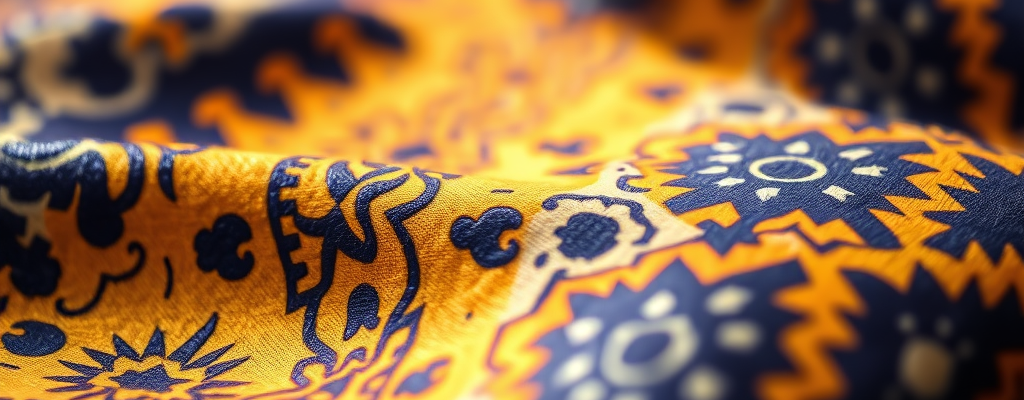
There are textiles that tell stories not in words, but in pattern and Adire, a traditional indigo-dyed cloth from the Yoruba people of southwestern Nigeria — is one of those textiles. Its name comes from the Yoruba phrase adi re, meaning “tie and dye.”
Every mark, fold, and resist tells a story — not only of craft, but of rhythm, history, and resilience.
Origins and Meaning
Adire developed in the early 20th century in Abeokuta, a Yoruba city known for its women dyers. The craft grew from local traditions of handspun cotton weaving and indigo dyeing. Women, often traders or market dyers, created resist patterns using raffia, cassava paste, or tied stitches before dipping the cloth into deep indigo vats.
The cloth was worn, traded, and gifted, it also carrying meaning across generations and geographies.
Each design bore a name, often poetic or proverbial:
- Olokun (“Goddess of the Sea”) — flowing spirals for abundance.
- Ibadandun (“Ibadan is Sweet”) — urban pride in pattern form.
- Alabere (“Needle and Thread”) — celebrating the maker’s craft.
In this way, Adire was both fabric and language — a visual conversation between women.
(Reference: Picton, J. “Adire Cloth in Nigeria,” The British Museum, 1995; Drewal, H. J. “Yoruba: Nine Centuries of African Art and Thought,” 1989.) (See further reading below)
The Process
The heart of Adire is indigo — once made from Lonchocarpus cyanescens, a local plant called elu. The leaves were soaked, fermented, and stirred into life, releasing that distinct, earthy scent and the magic of oxidation — where cloth turns from green to blue before your eyes.
Traditional methods include:
- Adire oniko — tied or stitched resist (using raffia).
- Adire eleko — starch resist (cassava paste painted on with feathers or sticks).
- Adire alabere — stitched designs that create intricate motifs when unpicked.
(References: Barbour, J. and Simmonds, D., “Adire Cloth in Nigeria,” 1971; The Smithsonian National Museum of African Art.) (See further reading below)
A Women’s Artform
Adire has always been a female-led practice — part craft, part economy. In Abeokuta and Ibadan, dyers worked in family compounds, passing recipes, patterns, and vat secrets from mother to daughter.
During colonial rule and the rise of imported textiles, Adire became a symbol of Yoruba identity and independence. Despite economic shifts and mass production, Adire persists — reinvented by artists, fashion designers, and educators who honour its origin while exploring new forms.
Today, creatives like Nike Davies-Okundaye (founder of Nike Art Gallery) continue to teach and exhibit Adire, merging heritage with modern expression.
(References: Nike Davies-Okundaye, “The Art of Adire,” Nike Art Foundation; Drewal, H. J., “African Textiles Today,” 2012.) (See further reading below)
Sustainability and Sensory Connection
Adire’s slow, plant-based process is a quiet act of sustainability — centuries before the term existed. It connects soil, water, air, and skin.
The tactile depth of the fabric — soft, slightly waxy from cassava, the scent of indigo — speaks to sensory design. It’s calm but alive, grounding yet expressive. For neurodivergent or sensory-sensitive designers, Adire is an example of how material experience can be both soothing and stimulating — structured, rhythmic, but never static.
Adire Today
Contemporary Nigerian designers like Lisa Folawiyo, Maki Oh, and Kiki Kamanu use Adire motifs in couture collections, proving that heritage craft can thrive in global design.
Workshops across Lagos and Abeokuta teach new generations to dye, design, and remember. Each vat stirred, each cloth rinsed, continues the story — one shade of blue at a time.
References & Further Reading
- Picton, John. African Textiles. London: British Museum Publications, 1989.
- This volume, published for the Trustees of the British Museum, includes detailed discussion of Yoruba indigo resist-dyed cloths (Adire) and is often cited alongside Picton’s curatorial notes on the subject.
- The British Museum collection database also contains entries on Adire textiles, with curator’s comments referencing Picton’s register and related scholarship.
- Example: British Museum Adire textile entry.
- Drewal, Henry John; Pemberton, John III; Abiodun, Rowland. Yoruba: Nine Centuries of African Art and Thought. New York: Center for African Art in Association with H.N. Abrams, 1989.
- A landmark exhibition catalogue presenting Yoruba art, cosmology, and cultural history across nine centuries.
- Full text is accessible via Internet Archive.
- Bibliographic details: 256 pages, richly illustrated, ISBN 0945802048 / 9780945802044.
- Barbour, Jan, and Simmonds, Dorothy.Adire Cloth in Nigeria. Ibadan: Institute of African Studies, University of Ibadan, 1971.
- This is one of the earliest comprehensive studies of Yoruba indigo resist-dyed textiles (Adire). It documents techniques, motifs, and cultural meanings, with photographs and fieldwork notes.
- Published by the University of Ibadan’s Institute of African Studies, it remains a foundational text for scholars of African textile traditions.
- OCLC Number: 476370. Copies are held in major academic libraries and archives.
- The Smithsonian’s National Museum of African Art in Washington, D.C. houses an extensive collection of African textiles, including Yoruba Adire cloths.
- Their collection database and exhibition catalogues provide detailed provenance, curatorial notes, and scholarly essays on indigo resist-dyeing traditions.
Online access: Smithsonian National Museum of African Art
- Davies-Okundaye, Nike.The Art of Adire. Lagos: Nike Art Foundation, n.d.
- Produced by the Nigerian artist and textile designer Nike Davies-Okundaye, this publication (and related exhibitions) document the history, techniques, and contemporary practice of Adire indigo resist-dyeing.
- The Nike Art Foundation, based in Lagos, is one of the largest centers for the preservation and teaching of Yoruba textile traditions.
- The Foundation’s resources include workshops, catalogues, and curated collections of Adire cloths.
- Online access: Nike Art Foundation.
- Drewal, Henry John. African Textiles Today. London: The British Museum Press, 2012.
- This richly illustrated book explores the continuing vitality of African textile traditions, including Yoruba Adire, in contemporary art and fashion.
- Drewal situates textiles within broader cultural, political, and social contexts, showing how cloth communicates identity and meaning in modern Africa.
- ISBN: 9780714125684.
- Available through the British Museum Press catalogue and academic libraries.
 Rachel Bakewell