In my earlier post about Art Before & After the Industrial Revolution, I traced industry’s imprint across the UK. Here I step closer- to the artists who faced the smoke and steel with brush in hand, asking: what does this mean for us?
The Industrial Revolution didn’t just alter landscapes—it transformed the artist’s gaze. As soot settled on skylines, where machines reshaped daily life, painters, printmakers, and designers began to respond. Their work became a mirror to progress and its price, a record of both awe and unease.
Social Commentary and Critique
And did Jerusalem builded here, Among these dark Satanic Mills?
Blake’s lament still lingers. As factories rose and cities swelled, artists turned their gaze towards the human cost of industrialisation. They bore witness to child labour, poverty, and the alienation of mechanised life.
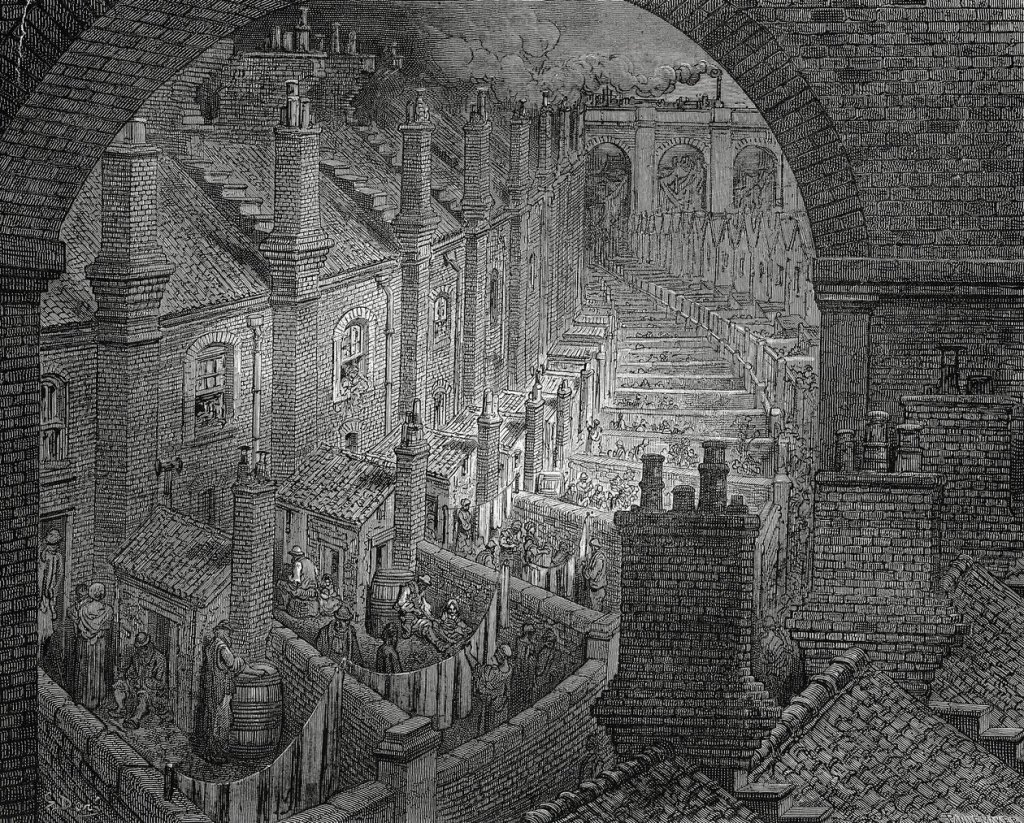
Gustave Doré Over London by Rail
- Artist: Gustave Doré
- Title: Over London by Rail
- Published in: London: A Pilgrimage (1872), with text by Blanchard Jerrold
- Medium: Wood engraving
- Context: This image captures the view from a railway viaduct over the slums of Southwark. Doré’s perspective — framed by the arch — emphasises the crushing density of tenement housing, the industrial smoke, and the human scale of poverty. It’s a visual indictment of Victorian inequality, contrasting technological progress with social neglect.
- Gustave Doré’s engravings of London’s slums distilled with the weight of soot and sorrow into unforgettable images.
- Social realists turned their gaze to miners, factory workers, and street children-portraying not symbols, but lives marked by fatigue, resilience, and quiet dignity.
If painters recorded the cost of industry, designers grappled with its aftermath in the home. Today, this gaze echoes in documentary photography, in community murals, in protective documentation—where care becomes critique, and clarity becomes resistance. Whether capturing a courier dispute or a moment of distress, your lens holds space for truth.
Design and the Decorative Arts
“Have nothing in your houses that you do not know to be useful, or believe to be beautiful.”
— William Morris
As mass production spread, design became both more accessible and more uniform. In response, the Arts and Crafts Movement emerged—not to reject industry outright, but to restore soul to the object.
- Morris’s vision was not nostaligic escapism. He responded to alienation in a different register than Doré – through craft, beauty, and the restoration of meaning in everyday objects.
- He was responding to alienation, just in a different register than Doré.
- William Morris and his peers revived traditional craftsmanship, weaving nature and narrative into wallpaper, textiles and type.
- Meanwhile, industrial printing allowed new motifs to reach middle-class homes-floral repeats, geometric borders, and visual comfort in a changing world.
Legacy: A New Artistic Consciousness
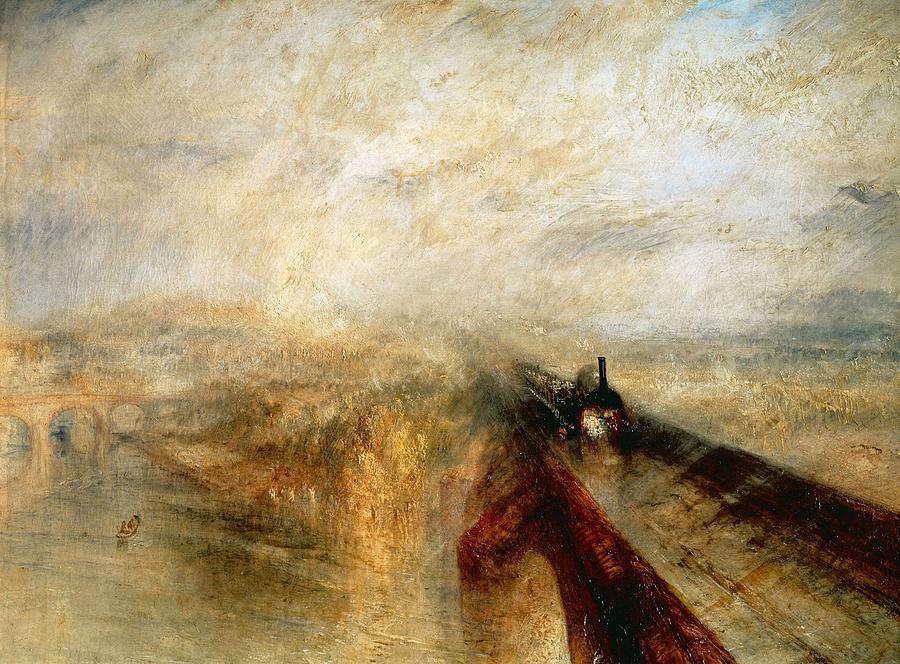
“Rain, Steam and Speed” (1844) — J.M.W. Turner
Rain, Steam and Speed — The Great Western Railway (1844), J.M.W. Turner. A vision of motion, mist, and modernity.
- Symbolism: The train is not just a machine; it’s a metaphor for progress, disruption, and the changing relationship between humans and landscape.
- Contrast with Doré: Where Doré’s engravings show the human cost of industry, Turner’s work evokes its sublime force — awe, fear, and transformation.
By the late 19th century, the artist’s gaze had widened: modern life itself – railways, factories, and the people within them – became worthy of art.
Further Reading:
- On Art and the Industrial Revolution
- How the Industrial Revolution Shaped Creative Expression — overview of Turner, Courbet, and Wright of Derby’s responses to industry. via The Art Insider
- Industrial Revolution: The Influence on Art — explores how mass production reshaped artistic practice and opened art to wider audiences. via St Art Amsterdam
- The Impact of the Industrial Revolution on Art: A Transformation of Soul and Society — analysis of Romanticism, Realism, and the rise of photography. via Anita Louise Art
- On Gustave Doré
- London: A Pilgrimage (1872) — Doré and Blanchard Jerrold’s original illustrated book, available in restored editions. Royal Academy of Art
- Gustave Doré’s London Pilgrimage — London Museum’s online resource with context and selected engravings. via Amazon & London Museum
- On William Morris and the Arts & Crafts Movement via William Morris Gallery
- The Cambridge Companion to William Morris, Chapter 16 – Morris and the Arts and Crafts Movement. via Cambridge University Press
- On Turner’s Rain, Steam and Speed. via The National Gallery
- J. M. W. Turner, Rain, Steam, and Speed — The Great Western Railway via Smart History
 Rachel Bakewell