Beauty has as many meanings as man has moods. Beauty is the symbol of symbols. Beauty reveals everything, because it expresses nothing. When it shows itself, it shows us the whole fiery-coloured world.
Oscar Wilde, 1890
I wanted to look at the different art movements during the industrial age.
The aim of the Aesthetic Movement in Britain (1860 – 1900) was “to escape the ugliness and materialism of the Industrial Age, by focusing instead on producing art that was beautiful rather than having a deeper meaning – ‘Art for Art’s sake’. The artists and designers in this ‘cult of beauty’ crafted some of the most sophisticated and sensuously beautiful artworks of the Western tradition and in the process remade the domestic world of the British middle-classes.”
The new “Aesthetic artists” include:
Dante Gabriel Rossetti

Jane Morris, posed by Rossetti, photograph by John R. Parsons, 1865, England. Museum no. 1748-1939. © Victoria and Albert Museum, London
‘Have nothing in your houses that you do not know to be useful or believe to be beautiful.’
William Morris

Fruit, wallpaper, designed by Morris, William, published by Morris & Co., 1865 – 66, London, England
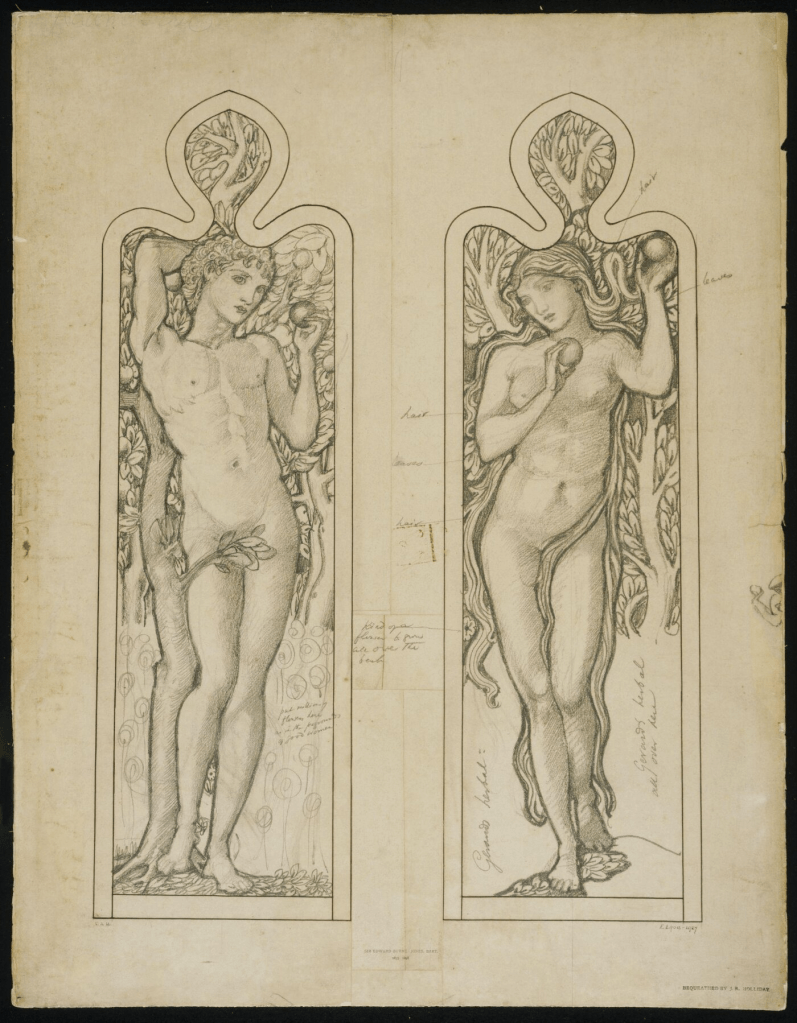
Adam and Eve
Stained Glass Design
1870s-1880s (made)
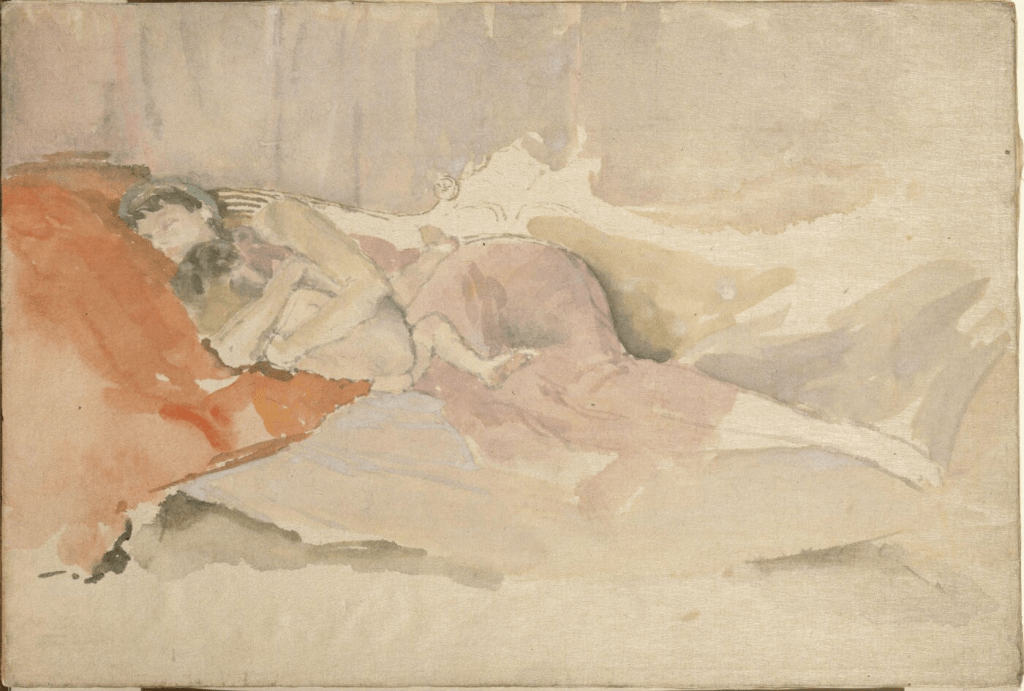
Mother and Child on a Couch
Watercolour
ca. late 19th century (made)
“…then fresh from Paris and full of ‘dangerous’ French ideas about modern painting; avant-garde architects and designers such as E.W. Godwin and Christopher Dresser; and the ‘Olympians’, the painters of grand classical subjects who belonged to the circle of Frederic Leighton and G.F. Watts.”
 Rachel Bakewell